
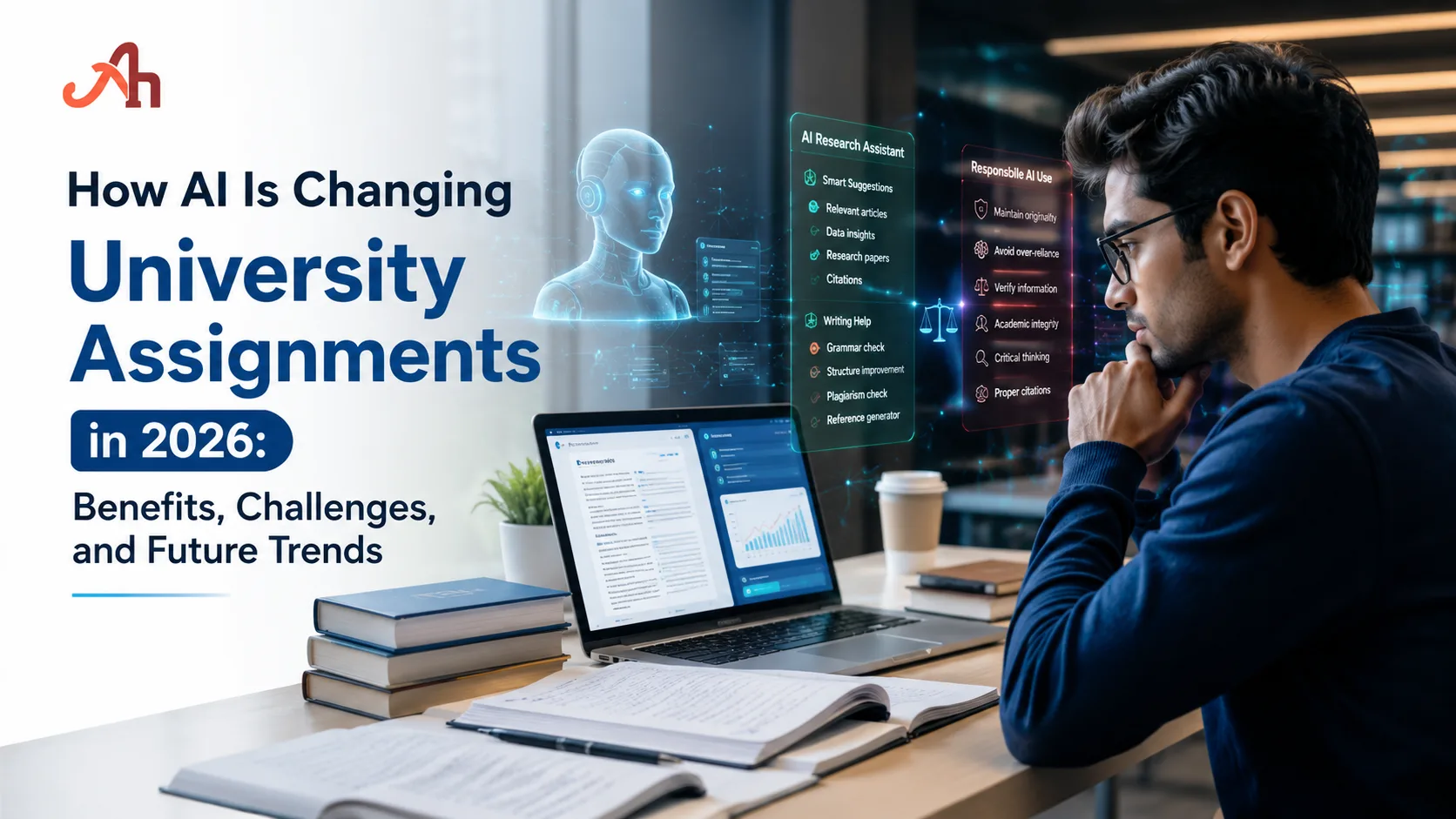
Artificial intelligence has moved from science fiction into every student's laptop — and in 2026, it is fundamentally reshaping how university assignments are written, graded, and submitted. From AI-generated essay drafts to intelligent plagiarism checkers, the academic landscape has never changed so fast. Whether you are studying engineering, law, business, or data science, AI tools are now part of your everyday workflow. In this blog, we explore the real benefits, the genuine challenges, and the exciting future trends every student needs to understand right now.
What Has Changed in University Assignments in 2026?
University assignments have undergone a dramatic shift. Professors no longer just assign a topic and wait — they now design tasks that require critical thinking, real-world application, and originality that AI alone cannot fake.
1. Assignment Formats Are Evolving
Traditional essay writing is being replaced or supplemented with oral defences, video presentations, and reflective journals.
Case study assignments now require live data analysis, not just theoretical responses.
Dissertation and thesis chapters demand primary research, making pure AI generation insufficient.
Coursework is increasingly project-based, focusing on process documentation alongside final output.
2. AI Detection Is Mainstream
Universities in Australia, the UK, and the USA are now using AI detection tools like Turnitin's AI Writing Detection alongside traditional plagiarism checks. A clean similarity score is no longer enough — originality of thought is being evaluated more rigorously than ever.
3. AI Is Now a Collaboration Tool, Not a Replacement
The smartest students in 2026 are not letting AI write their work — they are using it to brainstorm, outline, proofread, and format references. This collaborative approach is what universities now encourage within ethical guidelines.
Benefits of AI for University Students
Faster Research & Summarisation
AI tools can scan dozens of academic papers and summarise key arguments in minutes, helping students working on subjects like economics, management, and psychology to build stronger literature reviews faster.
Better Proofreading & Grammar
Real-time grammar and style suggestions improve final submission quality.
Especially helpful for international students working on essay writing in English.
AI-powered proofreading help reduces careless errors before submission.
Data Analysis & Coding Support
Students in data science, machine learning, and computer science benefit enormously from AI-assisted debugging, code generation, and statistical analysis — cutting project time by up to 50%.
Personalised Learning Pathways
AI tutors adapt to individual knowledge gaps in subjects like mathematics, accounting, and engineering.
Intelligent flashcard systems improve exam preparation efficiency.
Adaptive quizzes reinforce weak areas without wasting time on mastered content.
Challenges & Academic Integrity Concerns
While AI brings real advantages, it has also created serious concerns that every student must understand before submitting their next assignment.
The Academic Dishonesty Risk
Submitting AI-generated text as your own work violates most university academic integrity policies.
Penalties range from a failed grade to permanent expulsion, depending on the institution.
AI-detection tools are becoming more accurate — watermarked outputs from leading models are now traceable.
Over-Reliance Weakens Critical Thinking
Students who rely entirely on AI for homework help risk losing the ability to form independent arguments — a core skill tested in dissertation defences, viva voce exams, and professional careers.
Bias & Misinformation in AI Outputs
AI models can confidently produce incorrect facts, fabricated citations, and outdated statistics.
Always verify AI-generated content against peer-reviewed sources before including it in your work.
This is especially critical in law, medicine, and nursing assignments where factual accuracy is non-negotiable.
AI Impact Across Different Subjects
Engineering & Computer Science
AI code assistants have become standard in software engineering and artificial intelligence assignments. Students now need to understand, modify, and critically evaluate AI-generated code rather than write from scratch.
Law & Business
AI tools help students structure arguments for law assignments, summarise case law, and draft initial frameworks for MBA and business assignments. However, the analytical reasoning and legal judgement must remain the student's own.
Medical & Science
In medical and science coursework, AI supports literature reviews and data interpretation. But original lab work, patient case analyses, and clinical reasoning — areas covered by expert coursework help — still require genuine human understanding.
Other Affected Subject Areas
Finance & Accounting — AI-powered financial modelling tools
Economics — Predictive analysis and macroeconomic forecasting
Data Science & Machine Learning — AI workflow automation
Psychology & Sociology — AI sentiment analysis for research
Management — Strategic decision-making simulations
Future Trends in AI-Powered Academic Work
AI Co-Authors with Attribution
Several leading universities are already piloting a system where AI tools can be listed as a "co-author" with full transparency about which sections were AI-assisted. This framework balances innovation with integrity.
AI-Adaptive Assessments
Exams and assignments that dynamically change based on student responses in real time.
AI-generated personalised feedback within minutes of submission.
Automated rubric scoring that maintains consistency across thousands of students.
Multimodal AI Submissions
Students will soon be able to submit assignments as AI-narrated video presentations, interactive dashboards, or AI-structured research portfolios — assessed by a combination of human faculty and AI grading systems.
Verified Human Contribution Tracking
Blockchain-verified academic submissions that track every keystroke, edit, and source to ensure authentic student contribution are already being piloted. This will make genuine effort far more verifiable — and valuable.
Related Blog You Should Read
The Ultimate Guide to 120+ Original Oratory Topics for 2026
Looking for powerful, unique, and impactful speech topics? Discover 120+ original oratory topics across categories like technology, social justice, education, and more — carefully curated to help students win competitions and craft compelling speeches in 2026.
Read Full Blog on NeedAssignmentHelp
Conclusion
AI is not going away — and in 2026, the students who thrive are those who understand how to use it ethically, strategically, and creatively. The key is to treat AI as a powerful assistant, not a replacement for your own intellect and hard work. As universities continue to evolve their assessment methods, staying informed, maintaining academic integrity, and seeking expert assignment help when needed will be your strongest advantages. Use AI to learn faster, write smarter, and submit better — but always let your own critical thinking lead the way.
Frequently Asked Questions (FAQs)
1. Can I legally use AI tools for my university assignments in 2026?
Yes, but only within your university's stated AI policy — always disclose AI assistance and ensure all submitted content reflects your own critical thinking and original analysis.
2. Will AI-generated assignments be detected by university plagiarism tools in 2026?
Yes. Modern tools like Turnitin's AI detector and GPTZero can identify AI-generated text with increasing accuracy, making undisclosed AI use a serious academic risk in 2026.
3. Which university subjects are most impacted by AI assignment tools right now?
Computer science, data science, machine learning, law, business, and essay-based subjects have seen the greatest disruption from AI tools in academic assignments this year.
4. How can I improve my assignments without violating academic integrity policies?
Use AI for outlining, idea generation, and proofreading only — then write all arguments yourself, or seek help from legitimate expert assignment writing services.
5. What is the future of university assignments with AI over the next five years?
Future assignments will be multimodal, real-time, and AI-collaborative — with verified human contribution tracking making genuine student effort more transparent and valued than ever.