
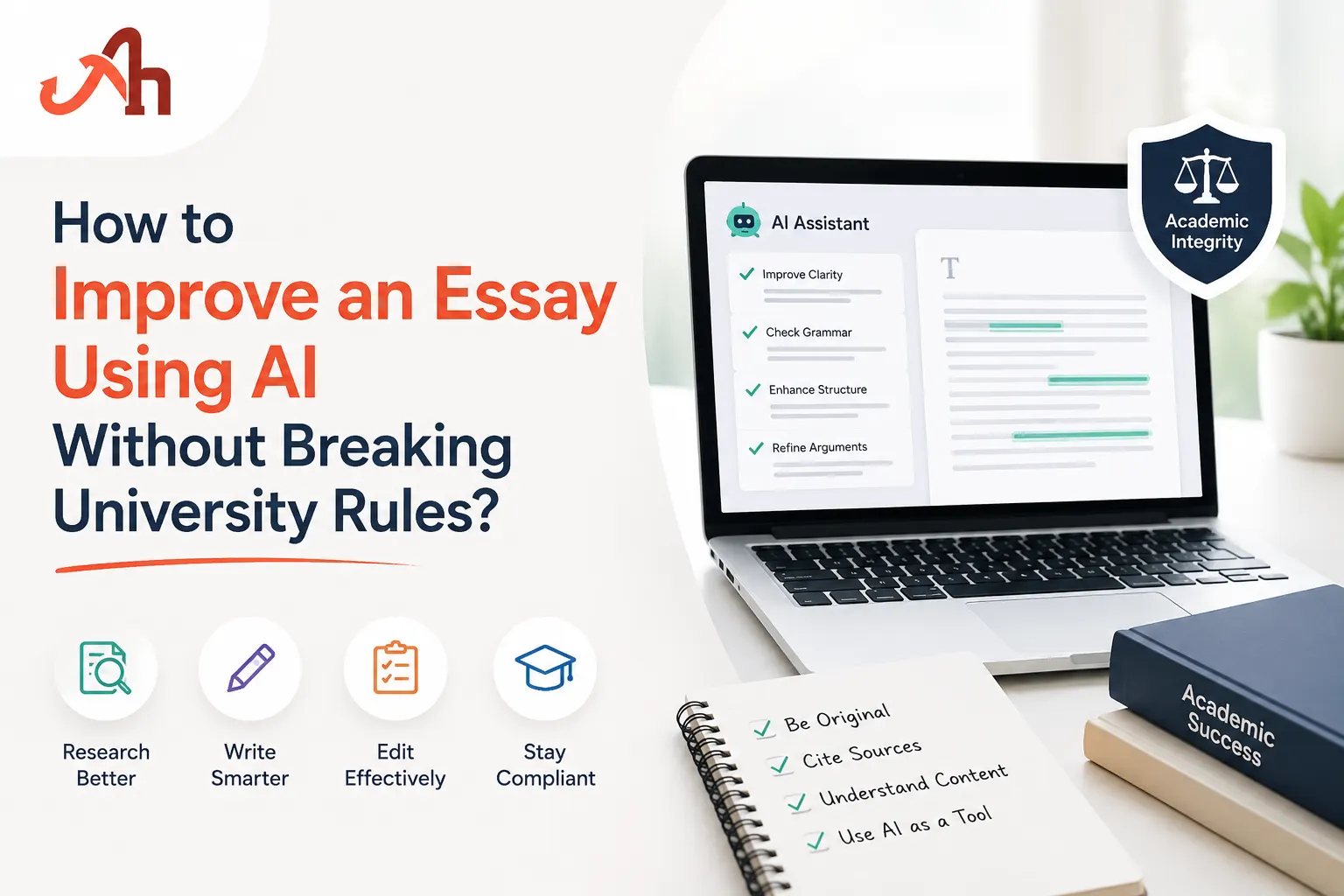
You can improve an essay using AI without breaking university rules if you follow four principles: read your course's AI policy first, use AI only for permitted tasks such as brainstorming, feedback, and grammar checks, keep every idea and sentence your own, and disclose your use when required. AI should coach your writing, not replace it.
This guide is for students who want a stronger essay without risking an academic integrity case. It reflects how universities are writing their AI rules in 2026, what students most often ask, and what you can do today.
Quick Answer: What Is Ethical AI Essay Improvement?
Ethical AI essay improvement means using AI tools for support tasks (brainstorming, outline feedback, clarity suggestions, and grammar checks) while you write the arguments, analysis, and final wording yourself. It also means following your instructor's AI policy and disclosing any use the policy requires.
Why This Topic Matters More Than Ever in 2026
Universities have moved from "ban it" to "govern it." Policies published or revised across the US, UK, and Australia in 2026 tend to share three themes:
Instructor rules come first. Many institutions say that if an instructor has not given explicit permission, students should assume AI is not allowed.
Transparency is the new baseline. Where AI is permitted, students are usually expected to say when and how they used it.
You are responsible for accuracy. AI can invent facts and sources, and universities hold the student accountable for every claim submitted.
Detection tools add risk. Reports from 2026 consistently describe AI detectors as imperfect: they can flag genuine human writing, and a well-known Stanford study found they disproportionately flagged essays by non-native English writers. More than 50 universities have reportedly discouraged or disabled detector use for this reason. Even so, a flag can start a stressful process, so your best protection is to follow the rules and keep evidence of your own work.
Step 1: Read Your University and Course AI Policy First
Before opening any AI tool, find the written rule for your specific assignment. A university-wide statement may be broad, while your instructor's syllabus is usually the rule that decides your case.
The Three Policy Types You Will Usually See
1. AI Prohibited
No generative AI at any stage. Even "light" use can count as a violation.
2. AI Permitted With Disclosure
You may use AI for defined tasks, but you must state how you used it.
3. AI Encouraged or Required
Some assignments are designed around AI use, such as critiquing AI output.
Pre-Use Checklist
Read the syllabus and assignment brief for an AI statement.
Check your university's academic integrity page.
Look for rules about which tools are approved. Some institutions provide secure, approved tools.
Ask your instructor in writing if the rule is unclear, and save the reply.
Do not paste confidential or unpublished research into unapproved tools.
Step 2: Know What AI Can and Cannot Do for Your Essay
AI is a feedback partner, not an author. Most policies that allow AI draw the line between assisting your thinking and replacing it.
Usually Acceptable Uses (When Your Policy Permits)
Brainstorming angles and counterarguments for your topic
Checking whether your outline flows logically
Explaining a confusing concept so you can write about it yourself
Pointing out unclear sentences, repetition, or weak transitions
Grammar, spelling, and punctuation checks
Generating practice questions to test your understanding
Usually Prohibited or High-Risk Uses
Generating full paragraphs or entire essays and submitting them as your own
Using AI-written analysis without disclosure
Letting AI create citations or quotes you have not verified
"Humanizing" or paraphrasing AI text to avoid detection
Uploading assignment material the university has restricted
Quick Comparison Table
Step 3: The Safe Workflow to Improve an Essay Using AI
Follow a draft-first workflow: write your own version, then use AI to critique it. This keeps authorship clear and gives you drafts to prove your process.
1. Write Your Own First Draft
Create your thesis, outline, and a rough draft before using AI. Save the file. Version history in Word or Google Docs creates a timestamped record of your work.
2. Ask AI for Feedback, Not Replacement Text
Prompt for diagnosis rather than rewriting.
Sample Feedback Prompts
"Identify the three weakest transitions in this paragraph and explain why they are weak. Do not rewrite them."
"Does my thesis statement make an arguable claim? Explain what is missing."
"List counterarguments a critical reader might raise against my main point."
Prompt Safety Note
Do not paste sensitive personal data, and do not upload material your course prohibits sharing.
3. Revise in Your Own Words
When AI flags a weak point, fix it yourself. Rewrite the sentence, add evidence, or restructure the paragraph so the final wording reflects your voice.
4. Verify Every Fact and Source
AI tools can produce confident but incorrect claims. Check each statistic, quote, and reference against a credible source you have read yourself. Never include a citation you have not confirmed exists.
5. Run a Final Quality Check
Check structure, clarity, and originality. A human-led review, such as proofreading help, catches tone problems and subtle errors that automated tools often miss.
6. Disclose AI Use if Required
Add a short statement describing what you used and for what purpose (see the disclosure section below).
How to Strengthen Each Part of Your Essay with AI Support
Improve the thesis, structure, evidence, and style one at a time. Targeted feedback produces better results than asking AI to "make it better."
Thesis Statement
Ask whether your claim is specific, arguable, and answerable within your word count. A strong thesis takes a position rather than announcing a topic.
Introduction and Conclusion
Use AI to test whether your introduction states the context, the problem, and your position. Check that your conclusion answers the "so what?" rather than repeating your introduction.
Body Paragraphs
Does each paragraph follow a clear point, evidence, analysis pattern?
Is every claim supported?
Are you analyzing evidence or only describing it?
Style and Tone
Ask for a list of overused words, passive constructions, or long sentences. Fix each yourself so the essay still sounds like you.
Essay-Type Tips: Where AI Helps and Where It Doesn't
Different assignments need different boundaries. Here is how to apply safe AI use across common formats.
Argumentative essays: Use AI to stress-test your logic and counterarguments. For a model of structure and evidence use, review an argumentative essay writing service sample for reference.
Reflective essays: These depend on your personal experience, so AI is a poor fit beyond grammar checks. Learn the format through reflective essay writing guidance.
Research papers: AI can help you organize themes, but you must read and cite the sources yourself. See research paper writing support for structure standards.
College and admission essays: Admissions readers want your authentic voice. Explore college essay writing and college admission essay resources for guidance on tone.
Scholarship essays: Personal stories carry the most weight, so keep AI to light editing. Review how to write my scholarship essay with an authentic voice.
Case studies: Use AI to check whether your frameworks (SWOT, PESTLE) are applied logically, then do the analysis yourself. See case study help for format expectations.
Longer projects: For a thesis or dissertation, supervisors often set stricter AI rules, so confirm them before you start.
Subject-Specific Cautions
The more technical or regulated your subject, the more carefully you must verify AI output.
Law: AI can invent case names and citations. Verify every authority and use the correct citation format. Students in law assignment help topics should treat AI as a drafting aid at best.
Nursing and medical subjects: Clinical accuracy matters. Check any health claim against your course materials. See nursing assignment help and medical assignment help for subject standards.
Computer science and programming: Many courses ban AI-generated code but allow concept explanations. Check the policy line by line if you need computer science assignment help.
Marketing and management: AI can suggest frameworks, but your analysis needs real examples. Explore marketing assignment help for what assessors expect.
English and humanities: Interpretation and voice are what get graded. Strengthen them through English assignment help rather than outsourcing the thinking.
How to Cite and Disclose AI Use
Disclose AI use whenever your policy requires it, and cite it in the format your department specifies. Transparency protects you, because failing to disclose permitted use is itself treated as a violation at many institutions.
What a Good Disclosure Includes
The tool name and version, where known
The date of use
What you used it for (for example, "feedback on essay structure")
A statement that the final ideas and wording are your own
Sample Disclosure Statement
"I used [tool name] on [date] to receive feedback on the clarity of my outline and to identify grammar errors. All arguments, analysis, and final wording are my own."
Citation Style Basics
Major styles now provide guidance for citing generative AI, though departments may add their own rules. If your course uses a specific format, follow it exactly. A dedicated referencing help resource can help you apply styles such as Harvard, APA, MLA, and Chicago correctly. For source lists, see also annotated bibliography guidance.
AI Detectors, False Flags, and How to Protect Yourself
AI detectors give probability scores, not proof, and they can be wrong. Their results can differ between tools, and they can misjudge formal, technical, or non-native English writing.
Build Your Evidence Trail
Keep dated drafts and version history.
Save your notes, outlines, and source highlights.
Keep any AI chat logs if you used AI within policy.
Be ready to explain your argument and sources verbally. Students who understand their work can usually do this easily.
If You Are Flagged
Stay calm and ask for the specific evidence and the tool used.
Share your drafts, notes, and version history.
Cite your institution's own process and policy.
Request a meeting rather than responding emotionally by email.
Reduce the Risk of Unfair Flags
Write in your natural voice and include specific details from your course readings.
Run a plagiarism check before submitting to catch accidental overlap.
Ask whether your institution accepts a Turnitin-style originality report as supporting evidence.
Common Mistakes Students Make With AI
Assuming silence means permission. Always confirm.
Trusting AI citations. Verify every source exists.
Using AI to "fix" AI. Paraphrasing generated text to evade detection is treated as deception.
Skipping disclosure. Hidden use is often punished more severely than disclosed use.
Losing your voice. Over-polished, generic prose can read as machine-written.
Over-relying on tools. If you cannot explain a sentence, it should not be in your essay.
When Human Academic Support Is the Better Choice
AI can't judge the tone your marker expects, the nuance of a rubric, or the standards of your subject. Human support helps when you need:
Expert review of structure and argument: Explore essay writing support and sample resources to understand high-scoring structure.
Final polish: Professional proofreading help refines grammar and flow without changing your ideas.
Learning from models: Browse assignment samples to see how strong work is organized, then apply those lessons in your own words.
Broader coursework support: Coursework help, university assignment help, and homework help can fill gaps when deadlines stack up. Use any provided material as a reference for learning and follow your institution's submission rules.
Conclusion
Improving an essay with AI is possible when it's done honestly and within the rules. Start with your policy, write your own draft, use AI as a critic rather than a ghostwriter, verify everything, and disclose your use when required. These habits protect your grades, your record, and your growth as a writer.
If you want to strengthen your work further, support such as proofreading help, a plagiarism check, and expert essay writing guidance from Need Assignment Help can help you submit with confidence.
Frequently Asked Questions
Q. Is it allowed to use AI to improve my essay at university?
It depends on your institution and instructor. Some courses prohibit AI entirely, while others allow it for brainstorming or editing with disclosure. Always check your syllabus and assignment brief, and ask your instructor in writing if the policy is unclear.
Q. Can I use AI for grammar checking without breaking the rules?
Often yes, but policies differ. Many universities treat basic spelling and grammar tools differently from generative AI that rewrites text. Confirm whether your course allows grammar tools, and disclose use if required.
Q. Will my university know if I used AI on my essay?
Not always, because detectors are imperfect and can produce false positives and false negatives. However, instructors may notice sudden style changes, fabricated sources, or an inability to explain your own work. The safest approach is to follow the rules and keep your drafts.
Q. How do I cite or disclose AI use in an essay?
Check your department's required style, then state the tool, date, and purpose of use. Many styles, including Harvard, APA, MLA, and Chicago, provide guidance for citing generative AI, and some courses ask for a separate disclosure statement.
Q. What should I do if an AI detector wrongly flags my essay?
Ask for the specific evidence and tool used, then share your drafts, notes, and version history. Request a meeting and refer to your institution's academic integrity process. A flag alone is not proof of misconduct.