
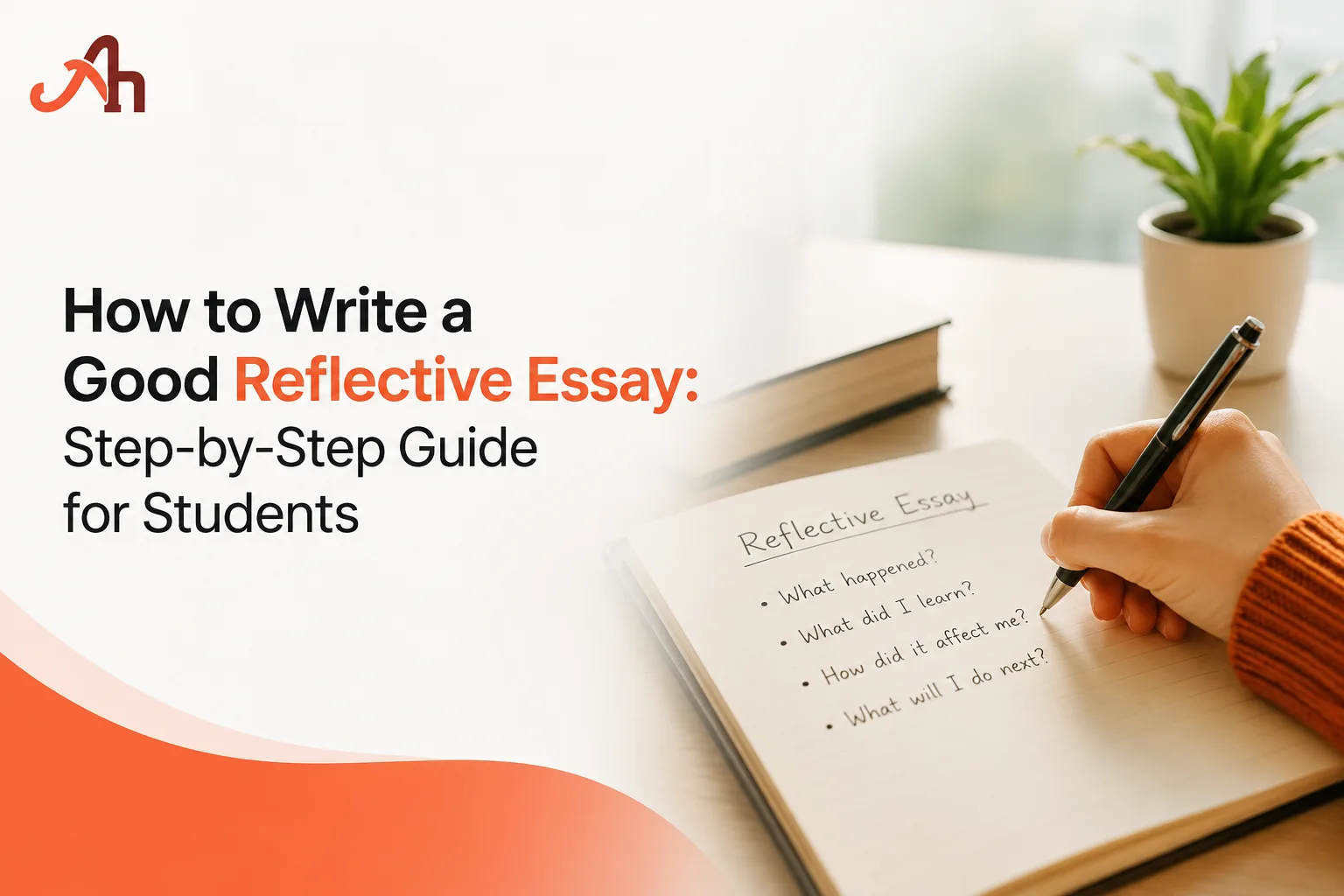
Knowing how to write a reflective essay comes down to one idea: describe an experience briefly, then spend most of your words explaining what it meant, what you learned and what you will do differently. If you want to see how a polished paper looks, our reflective essay writing help page shows what markers expect.
Many students lose marks because they retell a story instead of analysing it. This guide gives you a clear process, a simple reflective essay structure, ready-to-use sentence starters and the mistakes to avoid. It is written for school, college and university students in the USA, UK, Australia, Canada and beyond.
Quick Answer: How Do You Write a Reflective Essay?
To write a good reflective essay, follow these seven steps:
Read the prompt and marking rubric carefully.
Choose one specific, meaningful experience.
Brainstorm what happened, what you felt and what you learned.
Pick a reflective model such as Gibbs, Kolb or Rolfe.
Outline your introduction, body and conclusion.
Write in the first person, linking experience to theory.
Revise, proofread and check referencing before submitting.
What Is a Reflective Essay?
A reflective essay is an academic piece of writing in which you examine a personal experience, explain its impact and show what you learned. It combines storytelling with critical thinking, so your opinions, feelings and growth matter as much as the events themselves.
Reflective vs Narrative vs Descriptive vs Argumentative Essays
Students often confuse these formats. Here is the difference in plain language:
Reflective essay: focuses on meaning, lessons and personal growth.
Narrative essay: tells a story with a plot, setting and characters.
Descriptive essay: paints a vivid picture of a person, place or object.
Argumentative essay: defends a claim with evidence. If you need that format, see our argumentative essay writing service page.
Why Do Professors Assign Reflective Essays?
Reflective writing proves that you can connect classroom theory with real practice. Lecturers use it to assess:
Critical thinking and self-awareness
Your ability to apply theory to real situations
Communication skills and honesty
Professional growth, especially in nursing, teaching, social work and management
What Do Students Really Want to Know Before Writing One?
Search behaviour and student questions show the same worries again and again. Here are the answers up front:
Can I use "I"? Yes. Reflective essays are written in the first person unless your lecturer says otherwise.
How long should it be? Most are 500 to 1,500 words. Always follow your coursework brief.
Do I need references? Often yes, especially at university. Theory needs citations in APA, Harvard or your required style.
Is a personal story enough? No. Description is the smallest part. Analysis earns the marks.
Will it be checked for originality? Many institutions run similarity and AI-writing checks, so your own voice and real details are your best protection.
How to Write a Reflective Essay: 9 Steps
Step 1: Understand the Prompt and Marking Rubric
Start by identifying what the question asks you to reflect on and which criteria carry the most marks. Underline the command words such as "evaluate", "analyse" and "link to theory".
Note the word count, referencing style and deadline.
Check whether a specific model (for example Gibbs) is required.
Ask your tutor if anything is unclear. Stuck on the brief? Our assignment help experts can explain what a prompt is really asking.
Step 2: Choose a Strong Reflective Essay Topic
The best topic is a single moment or experience that changed how you think, act or work. Narrow topics give you depth; broad topics give you vague summaries.
Reflective Essay Topic Ideas
A group project that went wrong and what it taught you about teamwork
Your first clinical placement or work experience
A presentation that did not go to plan
A failed exam and how you changed your study habits
Learning a new language or skill
A volunteering experience that challenged your beliefs
An ethical dilemma you faced in an internship
Choose by Subject
Reflection is a core skill in many courses, including nursing, early childhood education, psychology, health and social care and management. Pick a topic from your own course placement so your examples feel authentic.
Step 3: Brainstorm Your Experience
Before drafting, write rough notes in answer to these questions:
What happened, and where and when?
What did I think and feel at the time?
What went well? What did not?
Why did it happen that way?
What did I learn about myself and my subject?
What will I do next time?
These six questions already form the skeleton of your essay.
Step 4: Choose a Reflective Model
A reflective model gives your analysis a reliable framework. Three are used most often in universities:
Gibbs' Reflective Cycle
Graham Gibbs' cycle (1988) has six stages: description, feelings, evaluation, analysis, conclusion and action plan. It is very popular in nursing and health programmes.
Kolb's Experiential Learning Cycle
David Kolb (1984) describes four stages: concrete experience, reflective observation, abstract conceptualisation and active experimentation. It suits teaching, business and science courses.
Rolfe's "What? So What? Now What?" Model
Rolfe's framework (2001) is the simplest. "What?" describes the event, "So what?" analyses its meaning and "Now what?" sets future actions. It is ideal for short essays.
Which Model Should You Use?
Use whichever your lecturer names. If none is specified, choose Rolfe for under 1,000 words and Gibbs for longer, assessed work.
Step 5: Create a Reflective Essay Outline
A clear outline keeps your essay focused on reflection rather than storytelling. A reliable reflective essay format looks like this:
Introduction (10%): hook, brief context and thesis statement
Body paragraph 1 (20%): short description of the experience
Body paragraph 2 (25%): feelings, reactions and analysis
Body paragraph 3 (25%): link to theory, course concepts or scholarly sources
Conclusion (20%): key lessons and future action plan
If your task is part of a larger paper, such as an academic report or research paper, adjust these proportions to fit the brief.
Step 6: Write a Compelling Introduction
Your introduction should hook the reader, set the scene in one or two sentences and state what you learned. This final sentence is your thesis.
How to Start a Reflective Essay: Hook Ideas
A short, vivid moment: "My hands were shaking when I walked into the ward for the first time."
A surprising realisation: "I thought leadership meant giving orders. I was wrong."
A reflective question: "What does failure teach us that success cannot?"
Thesis Statement Example
"Leading my first group project taught me that listening is more powerful than directing, and it changed how I approach teamwork."
The same hook-and-thesis skills help in a college essay or college admission essay, so practise them here.
Step 7: Develop Your Body Paragraphs
Each paragraph should do one job: describe, analyse or connect to theory. Use the "Point, Experience, Analysis, Lesson" pattern for clarity.
Describe the Experience Briefly
Give only the details needed to understand your reflection. Two or three sentences is often enough.
Analyse Your Thoughts and Feelings
This is where the marks are. Explain why you reacted as you did and what assumptions shaped your behaviour.
Sentence Starters for Analysis
"I realised that..."
"This experience challenged my belief that..."
"Looking back, I can see that..."
"I responded this way because..."
Connect Your Reflection to Theory
Support your insights with one or two academic sources, such as a communication theory, a leadership model or a professional code of practice. Cite them correctly in APA, Harvard or your required style. If referencing feels confusing, our referencing style help guide covers the major formats.
Step 8: Write a Strong Conclusion
A good conclusion summarises your key lessons and states how you will apply them in future. Do not introduce new ideas here.
Restate your main insight in fresh words.
Show how you have changed.
Give one or two concrete actions for the future.
Step 9: Revise, Edit and Proofread
Leave your draft for a few hours, then read it aloud. Check structure first, then style, then grammar.
Does every paragraph include analysis, not just description?
Is your tone honest, reflective and academic?
Are citations and the reference list complete?
Run a plagiarism check to confirm originality.
Get a final proofreading pass for grammar and flow.
Reflective Essay Structure at a Glance
Reflective Essay Example Paragraph
Here is a short sample so you can see description, feeling and analysis working together:
During my first group presentation, I took charge and assigned tasks without asking for opinions. At first I felt confident, but by the rehearsal my teammates were silent and frustrated. I realised that my approach ignored their strengths. Drawing on Tuckman's team development model, I can see our group never moved beyond the "forming" stage because I avoided open discussion. In future, I will begin meetings by asking each member for ideas.
Notice how it moves from event to emotion, to analysis, to theory and then to action. You can browse more formats in our assignment samples library.
Common Reflective Essay Mistakes to Avoid
Retelling instead of reflecting. Keep description under one quarter of the essay.
Choosing a vague topic. "My life" is too broad; "my first night shift" is workable.
Ignoring theory. Most university tasks need scholarly support.
Being too negative or too perfect. Honest balance shows maturity.
Skipping the action plan. Markers want to see how you will grow.
Weak referencing. Missing citations cost easy marks.
Leaving no time to edit. Typos reduce credibility.
Expert Tips to Score Higher
Use specific details such as dates, places and short quotes from real conversations.
Show change: "Before, I believed... Now, I understand..."
Vary your sentence length to keep a natural voice.
Use past tense for events and present tense for lessons learned.
Keep a short reflective journal during placements so you never forget key moments.
Read your marking criteria again just before submission.
Reflective Essays in Different Subjects
Nursing and Healthcare
Nursing students reflect on patient care, communication and ethics, usually with Gibbs' cycle. Our nursing case study support shows how clinical examples are analysed.
Education and Childcare
Trainee teachers reflect on lesson delivery and classroom behaviour. Related coursework often appears in childcare and early years programmes.
Business and Management
Management students reflect on leadership, teamwork and decision making. Explore related topics in leadership, organizational behavior and project management.
Psychology, English and Humanities
These courses value self-awareness and theoretical links. Students also draw on skills from English studies to polish tone and structure.
Dissertations and Theses
Even advanced projects may include a reflective chapter. If you are working on one, our dissertation help and thesis help pages explain how reflection fits the wider structure.
Final Reflective Essay Checklist
My topic is one specific experience.
My thesis states the lesson I learned.
Description is brief; analysis dominates.
I linked my experience to at least one theory or source.
My conclusion includes a clear action plan.
My references are accurate and consistent.
I proofread and checked originality.
When Should You Get Expert Academic Support?
Writing about yourself can feel surprisingly hard, particularly when deadlines overlap or English is not your first language. If you are short on time, a subject specialist can show you a model structure and polish your draft. You can request essay writing support, homework help or university assignment help, and use the delivered paper as a reference to learn from. Ready to begin? Place your order in a few minutes, or browse the blog for more student guides.
Conclusion
Learning how to write a reflective essay is really about learning to think clearly about your own experience. Choose one meaningful moment, describe it briefly, analyse it honestly, link it to theory and finish with a practical action plan. Follow the nine steps in this guide, avoid the common mistakes and always leave time to edit.
Every reflective essay you write strengthens your critical thinking, which helps in every other assignment, from a case study to a final-year project. Start with your outline today, and let your honest voice do the rest.
Frequently Asked Questions
Q. What is the best structure for a reflective essay?
The best structure is introduction, body paragraphs and conclusion. The introduction states your thesis, the body describes and analyses the experience with theory, and the conclusion summarises lessons and future actions. Models such as Gibbs' cycle or Rolfe's "What? So what? Now what?" can organise the body.
Q. How do you start a reflective essay?
Start with a hook such as a vivid moment, a surprising realisation or a thoughtful question. Then add one or two sentences of context and finish with a thesis statement that explains what the experience taught you.
Q. How long should a reflective essay be?
Most reflective essays are between 500 and 1,500 words, but this depends on your course. Always follow your lecturer's word count. Allocate roughly 20% to description and the rest to analysis, theory and future action.
Q. Can I use "I" in a reflective essay?
Yes. A reflective essay is a personal analysis, so first-person language is expected and appropriate. Keep the tone academic, avoid slang and support your points with evidence or theory where required.
Q. What is the difference between a reflective essay and a narrative essay?
A narrative essay tells a story, while a reflective essay explains what the story meant. Reflective writing gives more space to analysis, emotions, lessons learned and personal growth than to the events themselves.