
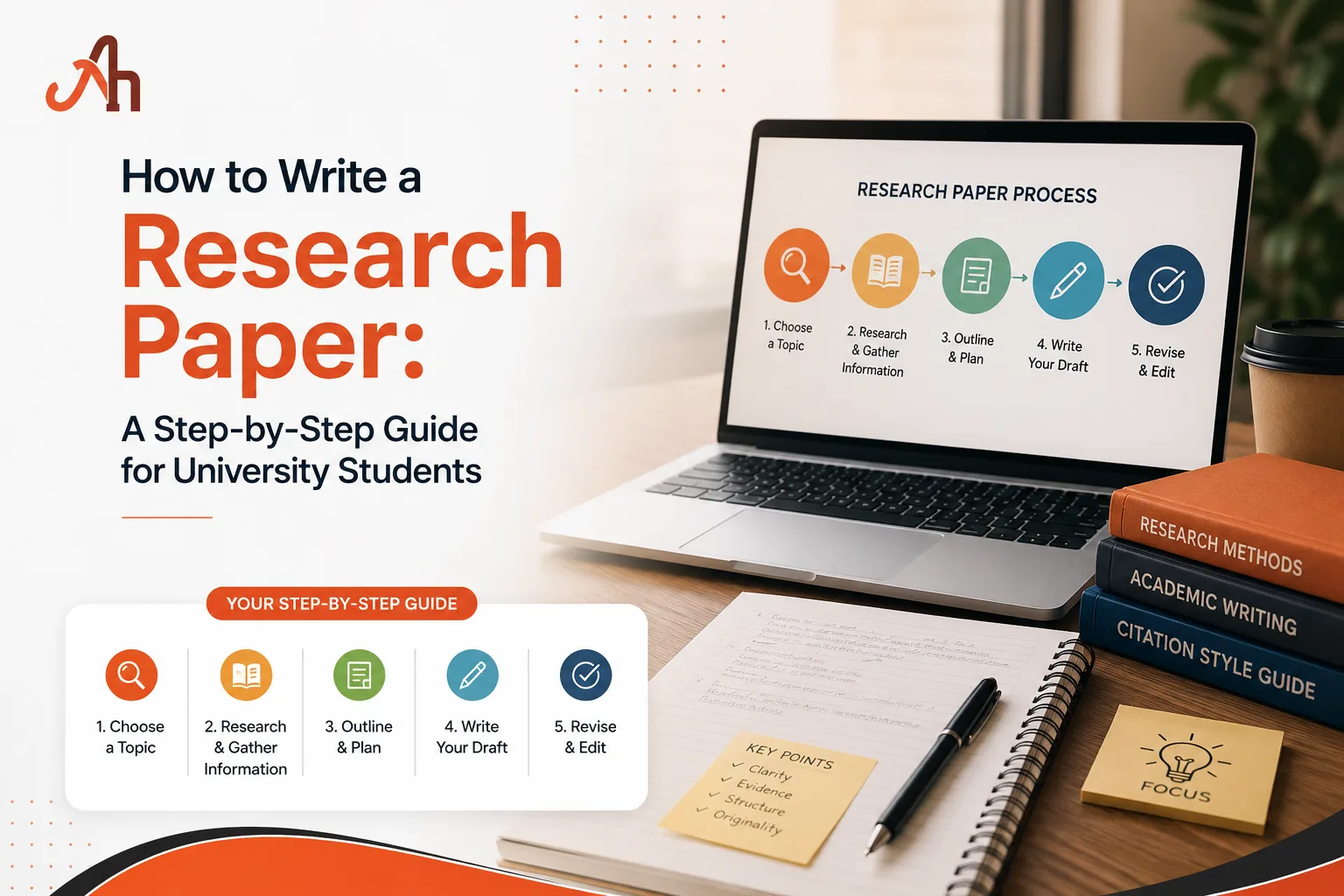
To write a research paper, choose a focused topic, run a preliminary literature search, build a thesis statement, create an outline, draft each section, cite every source, and finish with revision, proofreading, and a plagiarism check. Every university paper follows this sequence, whether it is 2,000 or 10,000 words.
Many students struggle with research paper writing because nobody shows them the process, only the finished product. This guide closes that gap. You will learn what examiners look for, how to plan your time, and where students lose marks. If you get stuck, our research paper writing help is available at any stage.
What Is a Research Paper?
A research paper is an academic document that presents your own analysis, argument, or findings on a specific question, supported by evidence from credible sources. It tests more than writing skill. It tests whether you can find, evaluate, and combine scholarly information into an original point of view.
Research Paper vs. Essay vs. Term Paper
Students often confuse these formats, which leads to misreading the assignment brief.
Essay: shorter, built around an argument, and often based on class readings. If your task is an essay, see our essay writing service or our argumentative essay writing service.
Research paper: longer, with independent research, a methodology or source strategy, and a formal structure.
Term paper: an end-of-semester paper that covers the full course. Get support through our coursework help.
Thesis or dissertation: a much larger project. See our thesis help and dissertation help.
Types of Research Papers You May Be Assigned
Argumentative: you defend a position with evidence.
Analytical: you break a topic into parts and explain how they relate.
Empirical: you collect and interpret original data.
Review-based: you summarise and evaluate existing research.
Why the Type Matters
Your type decides your structure, your sources, and your grading criteria. Read the brief twice before you start.
How to Write a Research Paper: 10 Steps
Step 1: Decode the Assignment Brief
Start by listing the requirements: word count, citation style, deadline, paper type, and marking rubric. Most lost marks come from ignoring the brief, not from weak writing.
Highlight command words such as analyse, evaluate, compare, or critically discuss.
Note the required referencing style (APA, Harvard, MLA, Chicago, or IEEE).
Check the weighting of each rubric criterion.
Email your lecturer if anything is unclear.
If the brief feels overwhelming, our university assignment help team can break it down for you.
Step 2: Choose a Focused, Researchable Topic
A good topic is narrow enough to cover in your word count and broad enough to have credible sources. "Social media" is too broad. "How short-form video affects attention among first-year undergraduates" is workable.
Use this quick test:
Can you phrase it as a question?
Are there at least 15 to 20 scholarly sources?
Does it interest you enough to spend weeks on it?
Can you finish it within the deadline?
Topic Ideas by Subject
Nursing: the effect of nurse-led discharge planning on readmission rates. See nursing assignment help.
Computer Science: bias in machine learning models. See computer science assignment help.
Law: data privacy and consent in contract formation. See law assignment help.
Marketing: consumer trust in influencer campaigns. See marketing assignment help.
Psychology: sleep, memory, and exam performance. See psychology assignment help.
Step 3: Run Preliminary Research
Preliminary research means reading widely and quickly to understand the debate before committing to an argument. Spend two to three days scanning your university library database, recent journal articles, and reference lists.
Record recurring authors, theories, and keywords.
Look for gaps, disagreements, and unanswered questions.
Save every source in a spreadsheet or reference manager from day one.
This gap is where your original contribution begins. If your project needs a formal plan first, use our research proposal writing help.
Step 4: Write a Strong Thesis Statement
A thesis statement is one or two sentences that state your central argument and signal how you will prove it. Everything in the paper should support it.
Weak: "This paper discusses remote work."
Strong: "Hybrid work improves employee retention when companies pair it with clear communication policies, but it widens career-progression gaps without structured mentoring."
A good thesis is specific, arguable, and provable with evidence. For management topics, see our management assignment help.
Step 5: Build a Detailed Research Paper Outline
An outline is a skeleton of your paper: headings, key points, and the evidence assigned to each section. It prevents rambling and saves hours of rewriting.
Introduction and thesis
Literature review
Methodology (if required)
Main body sections, one argument each
Discussion or analysis
Conclusion
References
What to Put Under Each Heading
The main claim of the section
Two or three pieces of supporting evidence
The source for each piece
A link sentence to the next section
Step 6: Conduct In-Depth Research and Take Smart Notes
Use peer-reviewed journals, academic books, and official reports, and evaluate each source for authority, accuracy, currency, and relevance. Prefer sources from the last five to ten years unless you are citing a classic theory.
Write notes in your own words to avoid accidental plagiarism.
Record page numbers for every quote.
Tag each note with the outline section it belongs to.
Capture opposing viewpoints. Examiners reward balanced analysis.
For source-heavy tasks, an annotated bibliography keeps your reading organised and helps you spot patterns.
Step 7: Write the Introduction (Last, if Possible)
A strong introduction states the context, the problem, the research question, and your thesis in about 10 percent of your word count. Many successful writers draft it last, once they know exactly what the paper argues.
Follow this four-part formula:
Hook: a relevant fact, question, or trend
Background: what the reader needs to know
Gap: what is missing or contested
Thesis and roadmap: your argument and structure
Step 8: Draft the Body Paragraphs
Each body paragraph should make one point, support it with evidence, and explain why it matters. A reliable pattern is Point, Evidence, Analysis, Link.
Open with a clear topic sentence.
Add one or two pieces of evidence.
Analyse the evidence. Never just quote and move on.
Close by linking back to your thesis.
Keep drafting without perfecting. Editing comes later. For technical or numerical papers, you may need specialist input, such as statistics assignment help, SPSS assignment help, or data analysis assignment help.
Step 9: Write the Conclusion
A conclusion restates your thesis in fresh words, summarises key findings, and explains the wider significance. Do not introduce new evidence.
Answer your research question directly.
Note limitations honestly.
Suggest realistic directions for future research.
Step 10: Cite, Revise, Proofread, and Check Originality
The final stage turns a good draft into a high-scoring paper. Allow at least 20 percent of your total time for it.
Referencing: apply one style consistently. Our referencing style help covers Harvard, APA, MLA, Chicago, OSCOLA, Turabian, IEEE, and Vancouver.
Revision: check structure and argument first, then paragraphs, then sentences.
Proofreading: read aloud, or use professional proofreading help for grammar, clarity, and flow.
Originality: run a plagiarism check before submitting.
Standard Research Paper Format (IMRAD)
Most scientific and social science papers use IMRAD: Introduction, Methods, Results, and Discussion. Humanities papers usually follow a thesis-driven argument structure instead.
Write the abstract last. It summarises finished work, so drafting it early usually means rewriting it. Reports and technical papers may need a different layout, so see our academic report writing help.
How to Use AI Tools Responsibly in 2026
AI tools can support your research process, but submitting AI-generated text as your own work can breach academic integrity rules. Universities now publish clear AI policies, and detection and viva-style questioning are increasingly common.
Acceptable Uses (Check Your Policy First)
Brainstorming topic angles
Explaining difficult concepts
Suggesting outline structures
Checking grammar after you have written the draft
Risky Uses
Generating paragraphs and submitting them as your own
Trusting AI-created citations without verifying them in a library database
Skipping the reading of sources
AI tools can invent references that look real. Always confirm every source exists. When in doubt, ask your department for its policy in writing.
8 Common Research Paper Mistakes (and How to Avoid Them)
Vague thesis: make it specific and arguable.
Too broad a topic: narrow it until it fits your word count.
Starting late: research and revision both need time.
Description instead of analysis: always explain why evidence matters.
Weak sources: favour peer-reviewed material.
Inconsistent referencing: pick one style and apply it everywhere.
No proofreading: typos undermine credibility.
Ignoring the rubric: match every criterion.
Studying a high-scoring model helps. Browse our assignment samples to see how structure, citations, and analysis come together.
A 6-Week Research Paper Time Plan
Breaking the project into weekly targets removes last-minute panic.
Short on time? Our assignment help team handles urgent deadlines.
Subject-Specific Research Paper Tips
Business and Case-Based Papers: use frameworks such as SWOT and PESTLE and connect theory to real scenarios. See case study help and business assignment help.
Economics and Finance: back claims with data, models, and clear interpretation. See economics assignment help and finance assignment help.
Engineering and Science: document methods precisely so others can reproduce them. See engineering assignment help.
Programming and IT: explain design choices, testing, and limitations. See programming assignment help.
When Should You Get Expert Help?
Seek support when deadlines overlap, the topic is highly technical, or English is not your first language. Getting guidance is a smart study strategy, not a shortcut, as long as you use the material to learn.
Expert help is useful for:
Understanding the structure of your paper
Building a strong research paper outline
Improving grammar, flow, and referencing
Reviewing a draft before submission
At Need Assignment Help, qualified writers provide original, plagiarism-free academic support with 24/7 availability. You can order now or read more about us. Our content is for reference and research purposes, so use it to guide your own work.
Conclusion
Writing a research paper becomes manageable once you treat it as a process rather than one huge task. Decode the brief, narrow your topic, build a firm thesis, outline carefully, draft with purpose, and leave real time for revision, referencing, proofreading, and a plagiarism check. Follow the ten steps above and the 6-week plan, and you will submit with confidence.
If you need a second pair of expert eyes, our research paper writing help is ready whenever you are.
Frequently Asked Questions
Q. How do I start writing a research paper?
Start by reading the assignment brief and noting the word count, citation style, and rubric. Then choose a narrow topic, run preliminary research, and write a working thesis statement. Only after that should you build an outline and begin drafting.
Q. How long does it take to write a research paper?
Most university research papers take three to six weeks, depending on length and complexity. Plan roughly 25 percent of your time for research, 40 percent for drafting, and 20 percent for revision and referencing. Dissertations and theses need much longer, so start with thesis help early.
Q. What are the main parts of a research paper?
A standard research paper has an abstract, introduction, literature review, methodology, results, discussion, conclusion, and references. Humanities papers may replace the methodology and results sections with thematic argument sections built around the thesis.
Q. How do I avoid plagiarism in my research paper?
Take notes in your own words, cite every idea you borrow, and use one consistent referencing style. Before submitting, run a plagiarism check and review your citations with referencing style help.
Q. Can I get professional help with my research paper?
Yes. Academic support services guide students through topic selection, outlining, editing, and referencing. Use the support as a learning resource and follow your university's academic integrity rules. You can explore assignment help or place an order any time.