
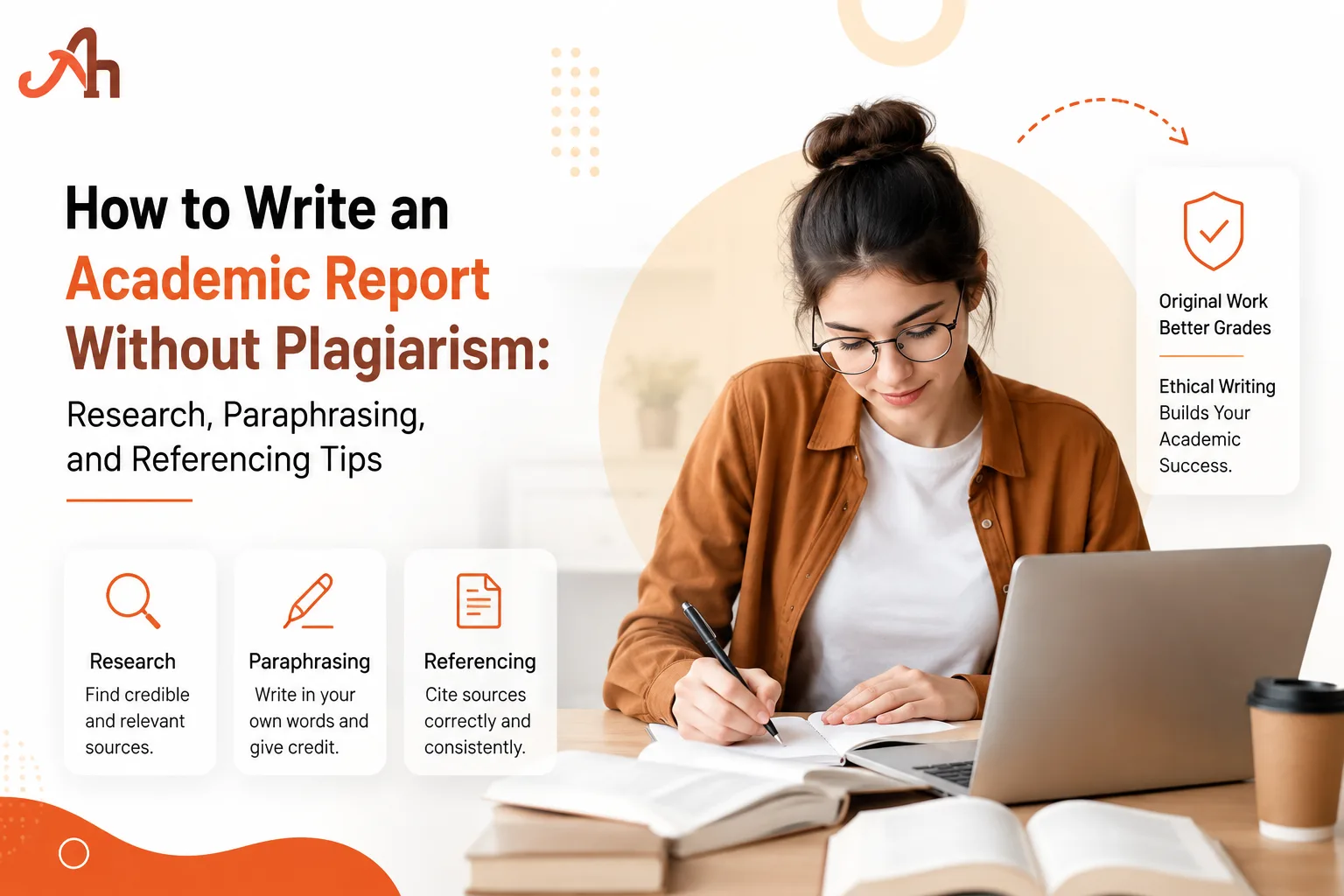
Every student dreads the moment a plagiarism checker flags their report, even when the copying was accidental. Between tight deadlines, dense research, and the temptation of AI writing tools, staying original can feel overwhelming — and the stakes are just as high for a plagiarism-free essay or a coursework submission as they are for a full report. This guide breaks down exactly how to research, paraphrase, and reference an academic report the right way in 2026. If you'd rather have an expert handle it, our academic report writing help team can guide you from outline to final citation.
What Is Plagiarism in an Academic Report?
Most students assume plagiarism only means copy-pasting a paragraph, but academic institutions flag several other forms too:
- Direct copying — using exact sentences without quotation marks or citation
- Patchwork plagiarism — stitching together phrases from multiple sources
- Self-plagiarism — reusing your own previously submitted work without permission
- Uncredited paraphrasing — rewording an idea but forgetting the citation
- Unedited AI content — pasting AI-generated text without review or fact-checking
These same rules apply whether you're writing a short report, a full dissertation, or a thesis — the definition of plagiarism doesn't change with word count.
Step 1: Research the Right Way Before You Write
Strong reports start with disciplined research, not a rushed Google search the night before submission. Good source management from day one is what actually prevents plagiarism later.
Choose Credible, Peer-Reviewed Sources
- Prioritize journal articles, government data, and textbooks over blogs or forums
- Use university databases and Google Scholar instead of generic search results
- Record the author, title, publication year, and page number the moment you open a source
Planning a longer project first? A well-structured research proposal makes it far easier to stay organized and cite consistently once you start the full report.
Take Structured, Not Copied, Notes
- Summarize ideas in your own words while reading — never copy sentences into your notes "for later"
- Use a citation manager such as Zotero, Mendeley, or EndNote to track sources automatically
- Separate your own analysis from source material clearly, using different colors or folders
If research and source-hunting is eating into your writing time, our research paper writing help service can compile credible, peer-reviewed sources for your topic before you even start drafting.
Step 2: Paraphrase Without Losing the Original Meaning
Weak paraphrasing is one of the most common reasons students get flagged, even when they never intended to copy anyone. Follow these steps for every source:
- Read the passage, then close it before writing your version from memory
- Change both the sentence structure and the word choice, not just synonyms
- Compare your version against the original to confirm no phrase overlap
- Add an in-text citation immediately, even though the words are your own
- Keep direct quotations under 10–15% of your total report
Even well-paraphrased writing can still read awkwardly on a first draft. A quick pass from our proofreading help service smooths out tone and flow without touching your original meaning or citations.
Step 3: Reference and Cite Every Source Correctly
Citation formatting is the single most common area where students lose easy marks — not because they didn't do the research, but because the referencing style was applied inconsistently. Every institution expects a specific format, and mixing styles is treated as a red flag by markers.
- APA — common in psychology, education, and social sciences
- Harvard — widely used across UK and Australian universities
- MLA — standard for literature and humanities reports
- Chicago/Turabian — used in history and some business reports
- IEEE — required for engineering and computer science papers
- Vancouver — used in medical and nursing reports
- OSCOLA — the standard for law assignments
Different departments often enforce their own formatting rules on top of the citation style, which is why university assignment help can be useful for matching your report to exact institutional guidelines.
Not sure which style your report needs, or how to build a consistent bibliography? Our referencing help service covers all major citation formats, including a properly formatted annotated bibliography if your report requires one.
Step 4: Run a Plagiarism Check Before You Submit
Even a carefully paraphrased, properly cited report should be checked before submission — accidental overlap happens more often than students expect. As of 2026, most universities run submissions through Turnitin, while students commonly self-check with tools like Grammarly or Quetext beforehand.
- Run your full draft through a plagiarism detection tool, not just the introduction
- Review every flagged section — some matches are legitimate citations, not plagiarism
- Fix any unintentional overlap by re-paraphrasing or adding a missing citation
- Save your originality report as proof of authentic work
This same originality check matters for every assignment type — from a lab report to a full case study — since markers use the same detection tools across formats.
Want a professional originality check before you hand it in? Our plagiarism check service gives you a detailed similarity report so you can fix issues before your professor sees them.
Should You Use AI Tools to Speed Up Report Writing?
Free AI writing tools can help you brainstorm an outline or simplify a confusing concept, but they're risky when used for the actual writing — AI-generated text carries its own detection risk and often fabricates sources. We've broken down exactly where AI tools help and where they fall short in our companion guide: Free AI Tools vs Professional Assignment Help: Which One Works Better? — worth reading before you rely on ChatGPT for your next report.
Quick Checklist Before You Submit Your Report
- ✅ Every quoted sentence is under 15 words and inside quotation marks
- ✅ Every paraphrased idea has an in-text citation
- ✅ Your reference list matches your institution's required style
- ✅ You've run the final draft through a plagiarism checker
- ✅ Any AI-assisted content has been fact-checked and rewritten in your own voice
Conclusion
Writing an academic report without plagiarism comes down to three habits: research from credible sources, paraphrase in your own words, and reference consistently in the required style. Build these into your process early, and originality checks become a formality instead of a worry. If you'd rather have a subject-matter expert manage the entire process, explore our assignment help service for plagiarism-free, properly referenced reports delivered on your deadline — or check out our homework help service if it's a smaller task with a tighter turnaround.
Frequently Asked Questions
Q. What is the easiest way to avoid plagiarism in a report?
Research from credible sources, paraphrase fully in your own words, and cite every idea consistently using your required referencing style.
Q. Does paraphrasing still need a citation?
Yes. Paraphrased ideas still belong to the original author, so you must cite the source even without direct quotes.
Q. Which referencing style should I use for my report?
It depends on your subject and institution — APA, Harvard, and MLA are most common; check your assignment brief first.
Q. Can AI-generated content count as plagiarism?
Yes, unedited AI content can be flagged by detection tools and violate academic integrity policies at most universities.
Q. How much of my report can be direct quotes?
Keep direct quotations under 10–15% of your total word count; the rest should be your own analysis and paraphrasing.