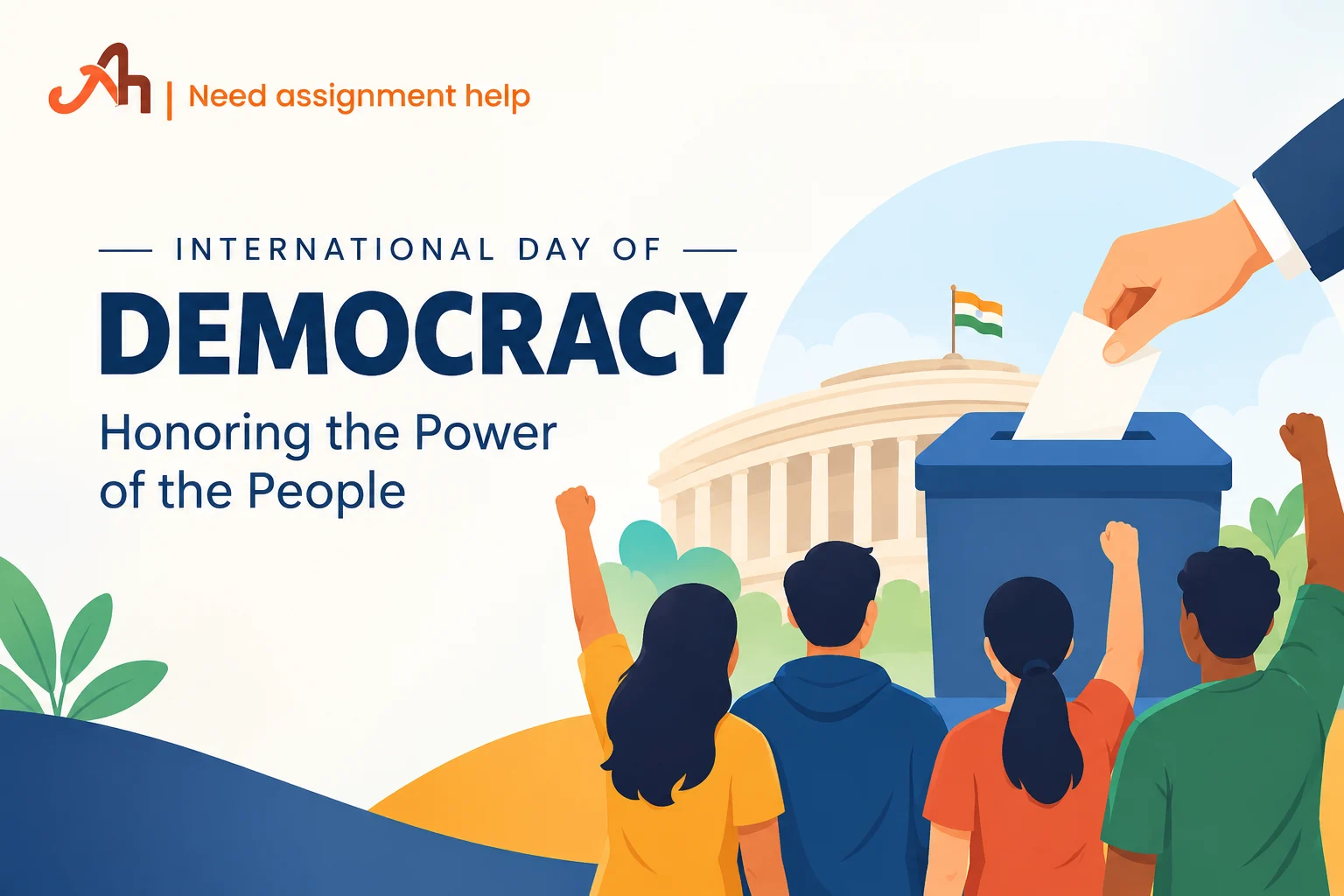
The International Day of Democracy is observed every year on 15 September to remind the world that government belongs to the people. In 2016, the day fell on a Thursday. The theme was “Democracy and the 2030 Agenda for Sustainable Development,” often shortened to “Democracy 2030.”
If you are a student preparing an essay, speech, or research paper on democracy, this guide covers the history, the 2016 theme, the main challenges, and the arguments you need.
Quick answer:
What: A UN-recognised day to review the state of democracy worldwide
When: 15 September every year (15 September 2016 for this edition)
Who created it: The UN General Assembly, in 2007
2016 focus: How strong, inclusive democracy supports the Sustainable Development Goals
What Is the International Day of Democracy?
The International Day of Democracy is a global observance on 15 September that encourages governments, institutions, and citizens to strengthen democratic values. Each year it asks whether democracy is working for the people it is meant to serve. Parliaments, schools, and civil society groups use the day to reflect and act.
History: How 15 September Became a Global Day
The day grew out of decades of work by parliaments and international bodies. Knowing this timeline lets you show depth in any history assignment.
The 1997 Universal Declaration on Democracy
In September 1997, the Inter-Parliamentary Union, the global organisation of national parliaments, adopted the Universal Declaration on Democracy. It set out the principles and practice of democratic government. At the Union’s suggestion, the date of the declaration was chosen as the day the world would celebrate democracy each year.
The 2007 UN Resolution
In November 2007, the UN General Assembly passed Resolution 62/7, which formally designated 15 September as the International Day of Democracy. Qatar played a leading role in the consultations behind it. The resolution encourages governments to strengthen and consolidate democracy. It also invites everyone, not only officials, to take part.
Why the History Matters for Students
Several concepts from this history appear again and again in university coursework:
Sovereignty of the people: Authority comes from citizens
Representation: Elected officials act on behalf of the public
Accountability: Leaders must answer for their decisions
Rule of law: Everyone, including the powerful, follows the same rules
These ideas run through constitutional law, international law, and sociology topics.
International Day of Democracy 2016 Theme Explained
The theme for 2016 was “Democracy and the 2030 Agenda for Sustainable Development.” It linked democratic governance to the global development plan the world’s leaders had adopted a year earlier, in September 2015. The 2030 Agenda contains 17 Sustainable Development Goals (SDGs), which came into effect in January 2016.
In his message for the day, UN Secretary-General Ban Ki-moon described the 17 goals as an intricate tapestry of challenges, choices, and opportunities in people’s everyday lives. He stressed that implementing them depends on a strong and active civil society.
Why Democracy and the SDGs Belong Together
Development goals cannot succeed if people have no voice in shaping them. Democracy gives citizens the means to set priorities, monitor progress, and demand results from their leaders.
The Role of SDG 16
SDG 16 calls for peaceful and inclusive societies, access to justice for all, and effective, accountable, and transparent institutions at every level. Many governments and parliaments used 15 September 2016 to renew their commitment to this goal. Parliaments in countries including Namibia, Algeria, India, and Peru took part in the observance, along with regional bodies such as the East African Legislative Assembly.
How Democracy Supports the 2030 Agenda: Simple Steps
Citizens take part in planning and setting local and national priorities
Parliaments pass laws and budgets that turn goals into action
Independent media and civil society monitor progress and expose gaps
Courts and institutions protect rights and enforce accountability
Voters respond at the next election by rewarding or replacing leaders
Student Takeaway
If you are asked to analyse the 2016 theme, argue that democracy is both a goal in itself and a method for achieving every other goal. A well-structured argumentative essay built on this idea can earn strong marks.
Why Democracy Matters: The Power of the People
Democracy matters because it protects individual rights, allows peaceful change of leadership, and gives every citizen a stake in public life. Where people can speak, vote, and hold leaders to account, governments tend to respond more closely to public needs.
Core Pillars of a Healthy Democracy
Free and fair elections: Regular, transparent, and open to all eligible citizens
Human rights and freedoms: Speech, assembly, belief, and equality before the law
Independent judiciary: Courts that check power, studied closely in law assignments
Free and responsible media: Citizens need accurate information, a topic central to mass communication and media studies
Active civil society: Community groups, unions, and student bodies that speak for people
Inclusive participation: Women, youth, minorities, and persons with disabilities have a real seat at the table
Democracy and Development
Democracy is closely tied to economic and social progress. Transparent institutions can reduce corruption, protect property, and build public trust. Students of economics and public relations often examine how stable governance supports investment, communication, and public confidence.
Democracy in Action: Examples from 2016
The year 2016 showed both the strength and the strain of democratic participation. Referring to real events makes any essay more credible.
Referendums: The United Kingdom’s June 2016 referendum on European Union membership drew a turnout of about 72 percent. It showed how direct votes can mobilise citizens, and how divisive they can be.
Transitions: Myanmar marked the day in 2016 with an event in its capital, as the country moved toward a civilian-led government after its 2015 elections.
Turnout concerns: Andorra’s parliament chose to focus its 2016 observance on falling election turnout, a trend seen in many countries.
Regional commitments: The African Union and the European Union issued a joint statement, reaffirming support for accountable and participatory institutions. The African Union had also declared 2016 the African Year of Human Rights, with a special focus on the rights of women.
These examples are useful for case study analysis, where you compare how different countries apply democratic principles.
Challenges Facing Democracy in 2016
Democracy faces pressures that every student should be able to explain: declining participation, unequal representation, weak institutions, and distrust of leaders. Naming and analysing these challenges shows critical thinking in any social science paper.
1. Falling Voter Turnout
When people feel their vote changes nothing, participation drops. Parliaments in several countries named turnout as a priority in 2016.
2. Unequal Representation
Women held just under a quarter of parliamentary seats worldwide in 2016, roughly 23 percent. Young people, minorities, and rural communities were also underrepresented. This gap is a central question in sociology and psychology research on political behaviour.
3. Weak Institutions and Corruption
Without independent courts, honest officials, and transparent budgets, elections alone cannot deliver good governance. Topics in business ethics, leadership, and philosophy explore what it means to hold power responsibly.
4. Limited Access to Information
Citizens need reliable facts to judge their leaders. Skills in statistics and data analysis help people test claims instead of accepting them blindly.
5. Delivering on Development
Democracy must show results. The 2030 Agenda covers poverty, health, education, gender equality, and climate action. Students of environmental studies, health and social care, and early childhood education can connect their fields directly to the SDGs.
How Students Can Honor the International Day of Democracy
Students can honor the day by learning how their own system works, taking part in civic life, and using their writing and research skills to raise informed voices. Small actions add up.
Practical Ways to Take Part
Register to vote as soon as you are eligible, and encourage friends to do the same
Join a debate or model parliament to practise reasoned argument
Study the SDGs and choose one goal you can support locally
Read your country’s constitution and note the rights it guarantees
Volunteer with a community or civic organisation
Write about it: a blog, op-ed, speech, or college essay on democracy
Check your sources before sharing political content
Ideas for Essays, Speeches, and Projects
Teachers often set democracy-related tasks around this date. Strong topic ideas include:
How does democracy help countries achieve the Sustainable Development Goals?
The role of SDG 16 in strengthening institutions
Why is voter turnout falling, and what can be done?
Women’s representation in parliament: progress and barriers
Direct democracy versus representative democracy: a comparative study
If you need structure for these, support with coursework and homework can save you valuable time.
Democracy Across Academic Subjects
Democracy is not limited to politics classes. It appears across many disciplines, which makes it a rich topic for interdisciplinary work.
How to Write a Strong Essay on the International Day of Democracy
A strong democracy essay has a clear thesis, balanced evidence, and a structure the reader can follow easily.
Define the concept. Start with what democracy means and why 15 September matters.
Write a debatable thesis. For example: “Democracy and sustainable development reinforce each other, because accountable institutions turn global goals into local results.”
Use credible evidence. Draw on constitutions, UN resolutions, scholarly work, and well-documented examples.
Present counterarguments. Acknowledge limits, such as corruption, unequal access, or slow decision-making.
Reference correctly. Follow your required style, whether APA, Harvard, MLA, or Chicago, using these referencing style guides.
Edit and check. Run a plagiarism check and a round of proofreading before you submit.
Planning Bigger Projects
Many students turn this topic into longer work. A research proposal, annotated bibliography, dissertation, or thesis on democracy and development is a rewarding choice. If deadlines or complexity feel overwhelming, professional assignment help and university assignment help can guide you from outline to final draft.
Conclusion
The International Day of Democracy is a yearly reminder that democracy is a living practice, not a finished achievement. The 2016 theme, “Democracy and the 2030 Agenda for Sustainable Development,” made the point clearly: the world’s biggest goals, from justice to health to education, depend on people having a real voice in how they are governed.
For students, the day is a chance to learn, question, and contribute. Whether you are preparing an essay, a debate, or a dissertation, understanding democracy builds the critical thinking you need in your degree and in public life. When you need support turning ideas into high-quality academic work, Need Assignment Help offers expert guidance across subjects and services.
Raise your voice. Honor the power of the people.
Frequently Asked Questions
Q. When is the International Day of Democracy celebrated?
It is celebrated every year on 15 September. In 2016 it fell on a Thursday. The UN General Assembly established the day in 2007, and the first observance took place in 2008.
Q. What was the theme of International Day of Democracy 2016?
The 2016 theme was “Democracy and the 2030 Agenda for Sustainable Development,” also promoted as “Democracy 2030.” It linked democratic governance to the 17 Sustainable Development Goals.
Q. Why is the International Day of Democracy important?
It gives people a moment to review the state of democracy worldwide. It reinforces rights, free elections, accountability, and inclusion, and encourages everyone to take an active part in public life.
Q. How is democracy connected to SDG 16?
SDG 16 promotes peaceful, inclusive societies and effective, accountable institutions. Democracy supports it by giving citizens a voice, protecting rights, and holding leaders responsible for results.
Q. How can students write an essay on the International Day of Democracy?
Define democracy, state a clear thesis, support it with credible evidence, and address counterarguments. Link the 2016 theme to real examples, cite sources in the required style, and proofread. For extra support, explore essay writing help.