
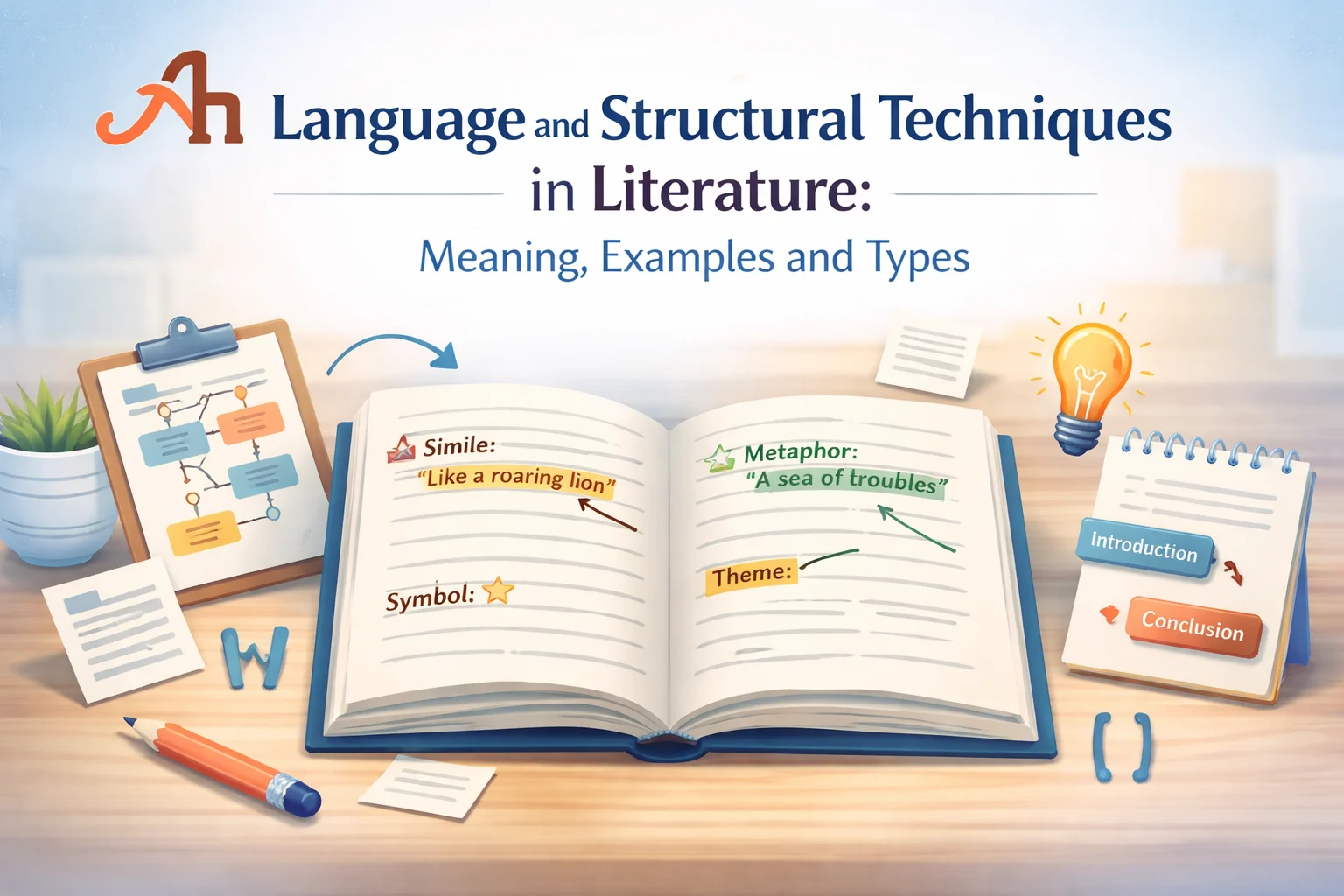
Understanding language devices and examples is a core skill every student needs to analyse texts with confidence. Whether you are tackling a GCSE poem, an A-Level novel, or working through a university-level essay writing task, knowing your literary tools gives you an analytical edge. This guide breaks down the most important literary techniques and meanings, provides real examples, and explains how structure shapes meaning — giving you everything you need to write stronger responses today.
What Are Language and Structural Techniques?
In simple terms, literary techniques and meanings refer to the deliberate choices a writer makes — both in vocabulary and in form — to shape how a reader thinks, feels, and interprets a text. These techniques operate on two levels:
Language techniques — the words, phrases, and figurative devices used at sentence level.
Structural techniques — the way a text is organised, sequenced, and formatted at a macro level.
Together, they form the backbone of all English language analysis techniques. Students who master both can decode any text — fiction, non-fiction, poetry, or drama — and produce compelling, well-evidenced analysis for coursework help tasks and beyond.
The Literary Devices List
Below is a focused literary devices list covering the techniques most frequently tested in exams and most commonly required in academic assignments.
1. Figurative Language Devices
Metaphor & Simile
Both compare two things, but a metaphor states the comparison directly while a simile uses "like" or "as." These are the most versatile language devices and examples in any writer's toolkit.
Personification
Personification gives human qualities to non-human things, creating emotional closeness between the reader and the subject.
Symbolism
A symbol uses a concrete object to represent an abstract idea. Recognising symbols is essential for any student seeking help with research paper writing or literary analysis.
A dove = peace and hope
A storm = conflict or internal turmoil
A broken mirror = shattered identity or bad luck
2. Sound Devices
Alliteration, Assonance & Onomatopoeia
Sound devices link language to physical sensation, pulling the reader deeper into the text's atmosphere.
3. Tone, Mood, and Diction
Diction — the specific word choices a writer makes — directly controls the tone (writer's attitude) and the mood (reader's emotional response). When you choose between "walked" and "stumbled", you make a tonal decision. This is central to all English language analysis techniques:
Formal diction — creates authority and distance
Colloquial diction — creates intimacy and relatability
Emotive diction — provokes a strong emotional response in the reader
4. Irony and Hyperbole
Irony
Irony creates a gap between what is said and what is meant, often used for satirical or comic effect. It forces the reader to think critically and is a favourite device in political writing.
Hyperbole
Hyperbole is deliberate exaggeration used to emphasise emotion or importance.
Writing Structure Techniques
While language works at the word level, writing structure techniques operate at the level of the whole text. Understanding structure is non-negotiable for students working on dissertation help or thesis help projects, as academic texts rely heavily on structural clarity.
Key Structure Techniques Examples
Circular Structure
The narrative ends where it began, suggesting cyclical themes like fate, repetition, or inability to escape the past.
Linear / Chronological
Events unfold in time order, creating clarity and often used in bildungsroman (coming-of-age) narratives.
Non-Linear / Fragmented
Flashbacks, flash-forwards, and disrupted timelines mirror psychological complexity or trauma in a character's mind.
Volta (Turn)
Common in poetry — a sudden shift in argument, emotion, or perspective, often at the final stanza or couplet.
Juxtaposition
Placing contrasting ideas, images, or characters side by side to highlight differences and deepen meaning.
Repetition & Motif
Repeated words, phrases, or images reinforce central themes and create a sense of inevitability across the text.
Why Structure Matters in Analysis
Good structure techniques examples analysis goes beyond identifying a feature — it explains the effect. Ask yourself: Why did the author choose to open here? Why does this scene come before that one? Why does the poem end with a couplet? These questions form the basis of strong homework help answers and exam essays alike.
Types of Literary Techniques
To consolidate your knowledge, here is a summary of the key types across both language and structure — ideal for revision before submitting a case study or completing a BTEC Assignment:
Language Technique Types
Figurative devices — metaphor, simile, personification, symbolism, allegory
Sound devices — alliteration, assonance, sibilance, onomatopoeia, rhyme scheme
Rhetorical devices — rhetorical questions, rule of three, anaphora, direct address
Tonal devices — irony, sarcasm, hyperbole, understatement, pathos
Narrative devices — first/third person narration, unreliable narrator, stream of consciousness
Structural Technique Types
Macro structure — overall narrative arc (exposition, rising action, climax, denouement)
Micro structure — sentence variety (short for impact, long for complexity), paragraph length, stanza form
Narrative positioning — in medias res (starting mid-action), flashback, foreshadowing, cliff-hanger
Poetic structure — free verse vs. fixed form (sonnet, villanelle), enjambment, caesura, end-stopping
How to Apply English Language Analysis Techniques in Exams
Knowing the techniques is only half the battle — applying them in a structured, evidence-based way is what earns marks. Follow this approach, also recommended for those seeking business development report writing or essay writing support:
The P.E.E. / P.E.A. Framework
Point — state the technique or effect clearly
Evidence — quote or reference directly from the text
Explanation / Analysis — explain exactly how and why the technique creates this effect
Common Mistakes to Avoid
Identifying a technique without explaining its effect ("The writer uses alliteration" — so what?)
Over-quoting without analysis — evidence should support your point, not replace it
Ignoring structure entirely — language and structure must both be addressed for full marks
Using vague language like "this makes the reader feel emotional" — be specific about which emotion and why
Conclusion
Mastering language devices and examples alongside writing structure techniques is not just an exam skill — it is a transferable analytical ability that strengthens all academic writing. From identifying a volta in a sonnet to recognising non-linear structure in a novel, every technique you learn adds depth to your interpretation and confidence to your voice as a writer.
Use the literary devices list in this guide as a revision reference, return to the structure techniques examples when planning your next essay, and always remember that analysis is about effect — not just identification. The more precisely you can explain how a technique works on a reader, the stronger your academic writing becomes.
Whether you need further English language analysis techniques practice or broader academic support, the resources linked above are here to help you succeed at every level of study.