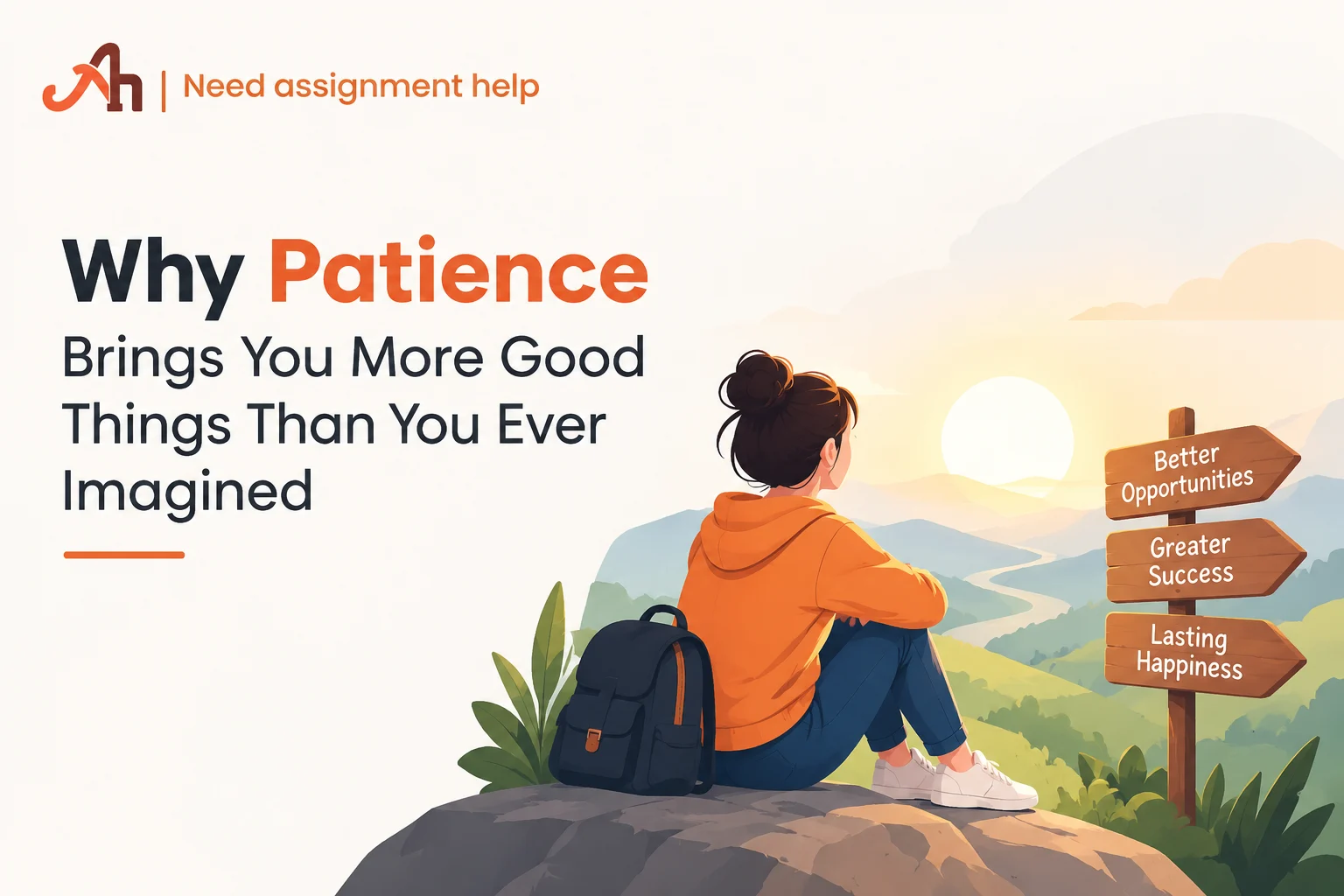
Why patience brings good things: Patience gives you time to build skills, make better decisions, and let steady effort grow into results. Students who stay patient with studying, research, and writing usually earn better grades, feel less stress, and find more opportunities than those who chase quick fixes.
It is midnight, and your assignment is due in the morning. You have not started the research, and your phone keeps lighting up with messages. Every student knows this feeling. The students who finish ahead are rarely the fastest. They are the ones who stay steady when results come slowly.
In 2016, we can stream a whole TV series in one weekend, order a taxi with one tap, and get a reply on WhatsApp in seconds. Our grandparents had to wait for letters. We barely wait for a web page to load. It is easy to forget that anything truly valuable still takes time. This guide explains why patience pays off, what research says about it, and how you can build it, whether you are writing an essay, planning a thesis, or preparing for your career.
What Is Patience? (Simple Definition)
Patience is the ability to stay calm, focused, and consistent while waiting for a result that does not come immediately. It is not passive waiting. It is steady effort combined with emotional control.
Patience has three parts:
Endurance: continuing when progress feels slow
Self-control: resisting the urge to quit or cut corners
Trust in the process: believing that small daily actions add up
Patience Is Not the Same as Laziness
Why the difference matters for students
A patient student still studies, writes, revises, and asks questions. A lazy student avoids work and hopes things change. Patience is steady action over time, not delay.
Why Patience Brings You More Good Things Than You Ever Imagined
Patience works because most valuable outcomes, like knowledge, skill, trust, and financial stability, grow through repetition over time. Rushing can give quick wins, but patience gives lasting ones.
1. Patience Lets Effort Compound
Think of learning like savings in a bank. One hour of study does little. Two hundred hours changes how you understand a subject. Students who quit at hour ten never see the payoff.
2. Patience Improves the Quality of Your Decisions
When you slow down, you read the question twice, check your sources, and choose a stronger argument. Impatient choices, like submitting an unchecked draft or picking the first topic you see, often cost marks. A short pause before acting is one of the easiest ways to improve your work.
3. Patience Builds Trust and Strong Relationships
Teachers, classmates, and employers notice people who stay steady under pressure. Reliability becomes your reputation, and reputation opens doors to recommendations, internships, and leadership roles.
4. Patience Reduces Stress
Impatience creates a loop: you rush, you make mistakes, you panic, and you rush more. Patience breaks that loop. Calm, steady habits are consistently linked with better wellbeing in student life.
What Research Says About Patience and Success
Research links patience, meaning the willingness to wait for a bigger reward, with better academic outcomes, healthier habits, and stronger long-term results. Here are four findings worth knowing as of 2016:
The marshmallow test. In the famous delayed-gratification experiments led by psychologist Walter Mischel, young children were offered one treat now or two treats if they waited. Follow-up studies reported that children who waited longer tended to show better self-control and school outcomes later on. The lesson is simple: the ability to wait is a powerful life skill.
Grit and perseverance. Psychologist Angela Duckworth’s research on “grit,” which combines passion with long-term perseverance, shows that sticking with goals predicts success at places like military academies and spelling bees. Her book Grit is one of the most talked-about titles of 2016.
Growth mindset. Carol Dweck’s work shows that students who believe they can improve through effort are more willing to keep trying after setbacks. Patience and a growth mindset work together.
Impatience and grades. Economics research on Italian university students found a strong negative link between impatience and exam grades. Impatient students spent less effort studying and set lower goals.
The pattern is clear: students who can wait, plan, and keep going tend to do better.
Benefits of Patience for Students in 2016
The main benefits of patience for students are better grades, deeper understanding, lower anxiety, stronger writing, and improved career readiness. Here is how each one shows up in real student life.
Better Grades and Deeper Learning
Patient students revise their drafts, read feedback, and practice difficult topics until they click. This matters in subjects that build on earlier lessons, such as mathematics, statistics, accounting, and programming. If you rush the basics, the advanced chapters become much harder.
Stronger Writing Skills
Good writing is rewriting. Patient writers plan, draft, edit, and proofread. If you struggle to polish your work, professional proofreading help can show you what a refined final draft looks like.
Lower Exam and Deadline Anxiety
Starting early and working steadily means you are not fighting a last-minute panic. Many students who feel overwhelmed benefit from structured assignment help to see how a large task can be broken into manageable parts.
Better Mental Health
Patience teaches you that a bad grade or a slow week is temporary. If you study psychology, you already know how emotional regulation supports wellbeing. Applying it to your own life makes a real difference.
Career Readiness
Employers value people who can handle long projects, accept feedback, and stay calm. Patience matters in every field, from nursing and law to engineering and marketing.
Why Patience Is Harder (and More Valuable) in 2016
Patience is harder in 2016 because smartphones, social media, and on-demand entertainment train us to expect instant results. That makes patient students rarer, and more valuable.
The Notification Trap
Every buzz from Facebook, Instagram, Snapchat, or WhatsApp breaks your focus. Studies on attention show that it takes time to refocus after an interruption. Switching your phone to silent during study time is one of the simplest patience habits you can build.
The Instant-Reward Trap
Binge-watching a full season overnight, same-day delivery, and games like Pokémon Go give quick rewards. Study gives slow rewards. If you only train your brain for instant results, long assignments feel painful. Balance fast fun with slow goals.
The Comparison Trap
Social media shows other people’s highlights, not their months of hidden effort. Comparing your chapter three to someone else’s chapter twenty is a recipe for frustration. Remember that every Olympic athlete you watched at the Rio Games in 2016 trained for years before those few minutes of competition.
Patience in Academic Life: Where It Matters Most
Patience matters most in long, complex academic tasks where quality depends on steady effort over weeks or months. Here is where students need it most.
Essay and Research Writing
A strong essay needs research, a clear thesis, good structure, and revision. If you are building these skills, explore guidance on essay writing, research paper writing, or the structured thinking behind an argumentative essay. A reflective essay is another example. It rewards slow, honest thinking rather than quick drafting.
Thesis and Dissertation Projects
These projects can take months. You will face unclear data, rewrites, and supervisor feedback. Students who plan in stages and stay patient finish stronger. If you need expert direction, dissertation help, thesis help, and research proposal writing help can keep you moving at a steady pace.
Case Studies and Coursework
Good analysis takes time. A strong case study needs frameworks, evidence, and clear recommendations. Ongoing coursework help can keep you consistent across a whole term, not just before a deadline.
Referencing and Originality
Careful citation is a patience skill. Rushing leads to missing references and accidental copying. A reliable routine with referencing style help and a final plagiarism check protects your academic integrity.
Applications and Scholarships
Strong applications are built over weeks. If you are preparing a college admission essay or need to write a scholarship essay, patience helps you tell a clear, honest story instead of a rushed one.
How to Be More Patient: 7 Practical Steps for Students
To become more patient, break big goals into small tasks, use a steady routine, limit distractions, track progress, and reward effort rather than only results. Follow these steps:
Break big goals into small milestones. Turn “finish my report” into “outline today, write the introduction tomorrow.” A project management mindset helps here: plan, schedule, review.
Build a simple daily routine. Even 45 focused minutes a day beats a six-hour panic session. Consistency trains patience.
Practice the 10-minute pause. When you feel like quitting or rushing, wait ten minutes before deciding. Most urges pass.
Silence your phone during study time. Turn off social media alerts and keep your phone out of reach. Patience grows when your attention is protected.
Track small wins. Keep a progress diary or checklist. Seeing evidence of progress makes waiting easier.
Ask for help early. Patience does not mean struggling alone. If a topic like data science, java, or economics feels stuck, getting guidance early saves weeks of frustration.
Celebrate effort, not only outcomes. Reward yourself for finishing a study session, not just for scoring high.
Patience vs Impatience: A Quick Comparison
Patience in Career, Money, and Life
Patience also pays off beyond college, because careers, savings, and relationships grow slowly and reward steady commitment.
Career growth: Promotions and expertise come from years of consistent work. Fields like leadership, HR management, and business development reward people who build trust over time.
Money habits: Saving and investing work through time. Students who study finance learn that compounding favors the patient.
Relationships: Friendships and teamwork grow through listening and giving others time. This is a core idea in organizational behavior.
Health: Fitness, sleep, and wellbeing improve slowly. Patience keeps you from quitting in week two.
Common Mistakes That Kill Patience
Expecting instant mastery of a new subject
Comparing your progress to other students online
Starting too late and then rushing everything
Treating one bad result as a final verdict
Ignoring rest, which makes frustration worse
Avoiding these mistakes protects your motivation. If you ever fall behind, structured homework help or university assignment help can get you back on track without panic.
Conclusion
Patience is not about waiting around. It is about showing up, trusting the process, and letting steady effort grow into results you could not rush. Students who build patience earn better grades, handle pressure more calmly, and create opportunities that impatient shortcuts never deliver. Start small today: plan one task, finish one study session, and give yourself time to improve. If you need expert guidance along the way, Need Assignment Help offers subject-wise support, and you can reach the team through the order page whenever you are ready.
Final thought: Good things do come to those who work and wait, and often they are bigger than you imagined.
Frequently Asked Questions
Q. Why does patience bring good things?
Patience gives effort time to compound. It improves decision quality, reduces stress, and builds skills and trust. These benefits grow slowly, which is why patient people often achieve bigger, longer-lasting results than those who rush.
Q. How can students become more patient with their studies?
Break assignments into small tasks, follow a daily routine, avoid last-minute work, and track your progress. If a subject feels difficult, seek guidance early through resources like assignment help rather than struggling alone.
Q. Does patience really improve grades?
Yes, in most cases. Research on university students has found that impatience is linked with lower average grades, less study effort, and lower goals. Patient students revise more, practice longer, and understand topics more deeply.
Q. Is patience a skill that can be learned?
Yes. Patience is a skill you can train through routines, goal-setting, and reflection. Research on self-control, grit, and growth mindset shows that students can improve these habits with practice and support.
Q. How do I stay patient when I have tight deadlines?
Split the work into stages, start with the hardest part, and avoid perfectionism. Plan time for editing, proofreading, and a plagiarism check. If time is truly short, expert support can help you stay calm and submit quality work.