
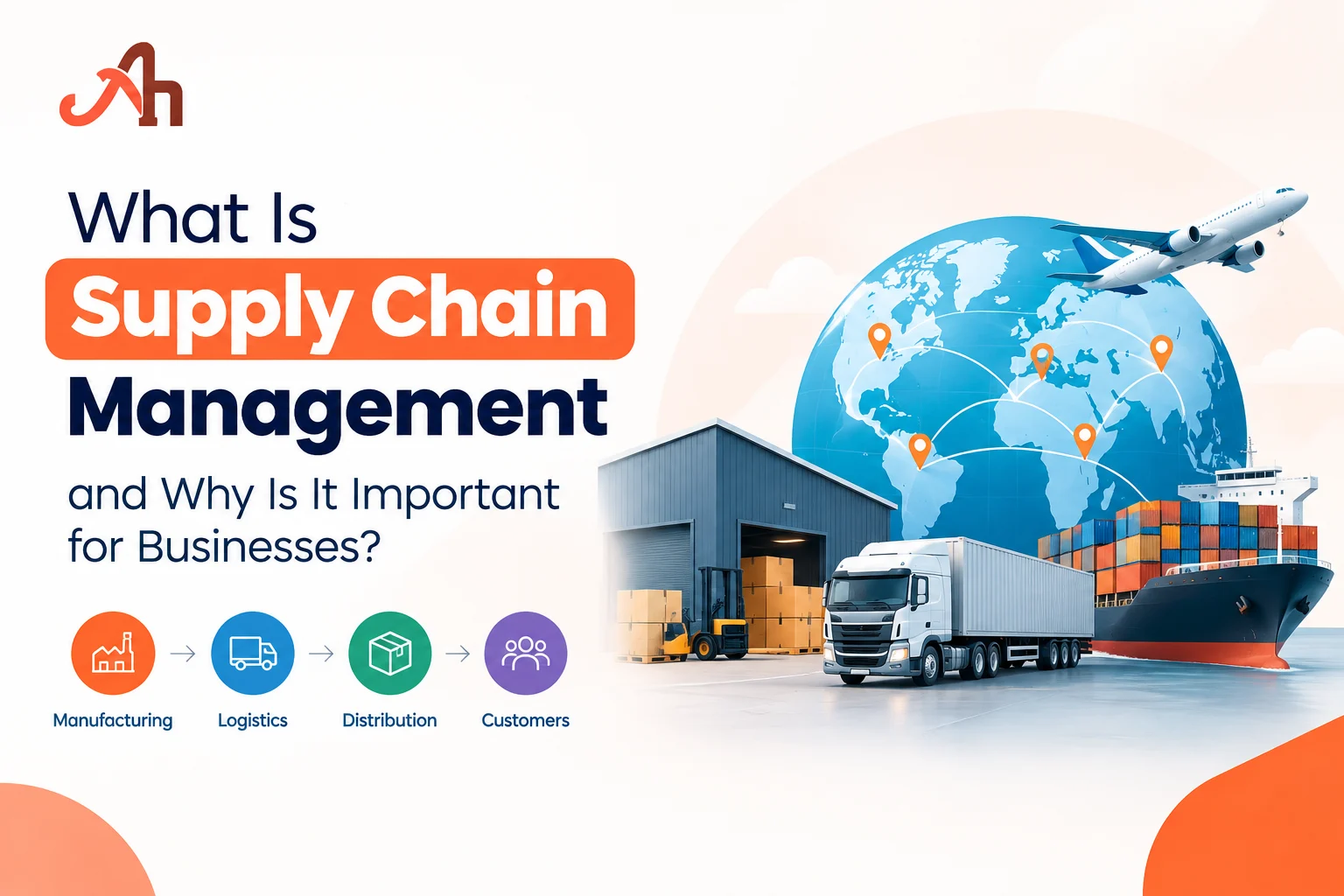
Every product on a store shelf — a phone, a textbook, a bag of coffee — passes through dozens of hands before it reaches you. Supply chain management (SCM) is the discipline that plans and controls that entire journey, from raw material sourcing to final delivery. For businesses, a well-run supply chain is often the difference between meeting delivery promises and losing customers to a faster competitor. This guide explains what supply chain management actually involves, why it matters to modern businesses, and what students studying operations management need to know about it.
What Is Supply Chain Management?
Supply chain management is the coordination of every activity involved in sourcing raw materials, producing goods, and delivering finished products to customers. It manages the flow of goods, information, and finances from supplier to end user, connecting procurement, production, logistics, and customer service into one system.
In simple terms, when a customer clicks "buy now," a hidden sequence starts: stock checks, supplier orders, warehouse picking, transport, and tracking, until the product lands at their door. SCM is the system that makes this sequence work without breaking. It sits at the core of business and management curricula because almost every industry — retail, healthcare, manufacturing, e-commerce — depends on it.
The Key Components of a Supply Chain
A supply chain typically runs through five connected stages:
Planning — forecasting demand and aligning production and inventory to match it.
Sourcing and procurement — selecting suppliers, negotiating contracts, and purchasing raw materials.
Production — converting raw materials into finished goods.
Logistics and distribution — warehousing, transport, and delivery to retailers or customers.
Returns (reverse logistics) — handling returns, repairs, and recycling.
Sourcing and Procurement
Procurement teams choose reliable suppliers, negotiate pricing, and manage supplier relationships — a topic students often cover under business development and vendor strategy coursework.
Logistics and Distribution
This stage moves goods from warehouse to shelf. It includes fleet routing, freight selection, and last-mile delivery, and is closely tied to operations management principles like capacity planning and process efficiency.
Why Is Supply Chain Management Important for Businesses?
SCM matters because it directly shapes cost, risk, and customer experience. According to Zoho's 2026 procurement research, the global SCM software market is growing from $62.73 billion in 2025 to $69.27 billion in 2026, driven largely by e-commerce expansion and AI adoption. Separately, McKinsey's 2025 Supply Chain Risk survey found that 82% of companies now report tariff changes actively affecting their supply chains — proof that SCM has become a board-level concern, not just a warehouse function.
Cost Efficiency and Profitability
Efficient sourcing, inventory control, and transport planning reduce waste and free up capital that businesses can reinvest elsewhere.
Risk Management and Resilience
Greater visibility across suppliers and logistics routes helps businesses spot disruptions early — a core theme in risk management case studies used in business schools.
Customer Satisfaction and Loyalty
Reliable stock availability and on-time delivery build trust, which is why SCM performance now shows up directly in customer retention metrics.
Competitive Advantage
Companies that master SCM can price more competitively and launch products faster, giving their marketing and sales teams a real edge over slower rivals.
Quick fact: Industry estimates place the global SCM market near $31 billion by 2026 for professional roles alone, with demand for skilled supply chain analysts and procurement managers currently outpacing supply.
Supply Chain Management vs Logistics Management
Students frequently confuse the two. Logistics is one part of the supply chain — it handles transport, warehousing, and delivery. SCM is the broader system that also includes sourcing, production, supplier relationships, and returns.
Emerging Trends in Supply Chain Management for 2026
AI-Driven Demand Planning
AI has moved from experimental pilots to running live planning rooms, helping businesses forecast demand and reroute shipments around disruptions in real time.
Sustainable and Green Supply Chains
Customers increasingly expect proof that a supply chain is genuinely sustainable, pushing companies to track emissions across every supplier tier.
End-to-End Visibility Technology
Digital tracking tools now give businesses live data across suppliers, warehouses, and carriers, making disruptions easier to catch before they escalate.
Studying Supply Chain Management: What Business Students Need to Know
SCM appears across MBA, business, and management programmes, usually as part of operations coursework.
Core Topics in SCM Coursework
Procurement and Supplier Relationship Management
Covers vendor selection, contract negotiation, and building long-term supplier partnerships.
Inventory and Warehouse Management
Focuses on stock forecasting, storage costs, and just-in-time inventory models.
Global Logistics and Distribution
Examines how goods move across regions and borders efficiently.
Domestic vs International Logistics
Domestic logistics deals with local transport regulations and shorter routes; international logistics adds customs, tariffs, and multi-currency contracts.
Example: Cross-Border Shipping Documentation
An assignment might ask students to map the customs paperwork, bills of lading, and tariff codes required to ship goods from a factory in Vietnam to a retailer in the UK.
Common Challenges Students Face with SCM Assignments
Applying frameworks like SCOR or Porter's Value Chain to real case studies rather than describing them in theory.
Structuring long, data-heavy essays and reports within word limits.
Citing current statistics correctly under styles like Harvard or APA.
Balancing SCM coursework with tight deadlines across multiple subjects.
Students who get stuck on these areas often turn to structured assignment help or homework help to clarify frameworks before writing their final draft.
Conclusion
Supply chain management is no longer a back-office function — it is a strategic driver of cost, resilience, and customer trust for businesses of every size. Understanding its five core stages, current 2026 trends like AI-driven planning, and how SCM differs from logistics gives students a real edge in operations and business coursework. If you're working through an SCM assignment or case study, operations management assignment help from experienced writers can help you apply these concepts with confidence.
Frequently Asked Questions
Q. What is supply chain management in simple terms?
It's the coordination of sourcing, production, and delivery so products reach customers on time, at the right cost, and with consistent quality.
Q. Why is supply chain management important for businesses?
It reduces costs, manages disruption risk, and improves delivery reliability, which directly boosts customer satisfaction and competitive advantage.
Q. What is the difference between SCM and logistics?
Logistics covers transport and storage only; SCM is broader, including sourcing, production, supplier relationships, and returns management.
Q. What are the main components of a supply chain?
Planning, sourcing and procurement, production, logistics and distribution, and returns management form the five core components.
Q. How can students get help with supply chain management assignments?
Reviewing real case studies and using professional assignment or operations management assignment help can clarify frameworks before submission.