
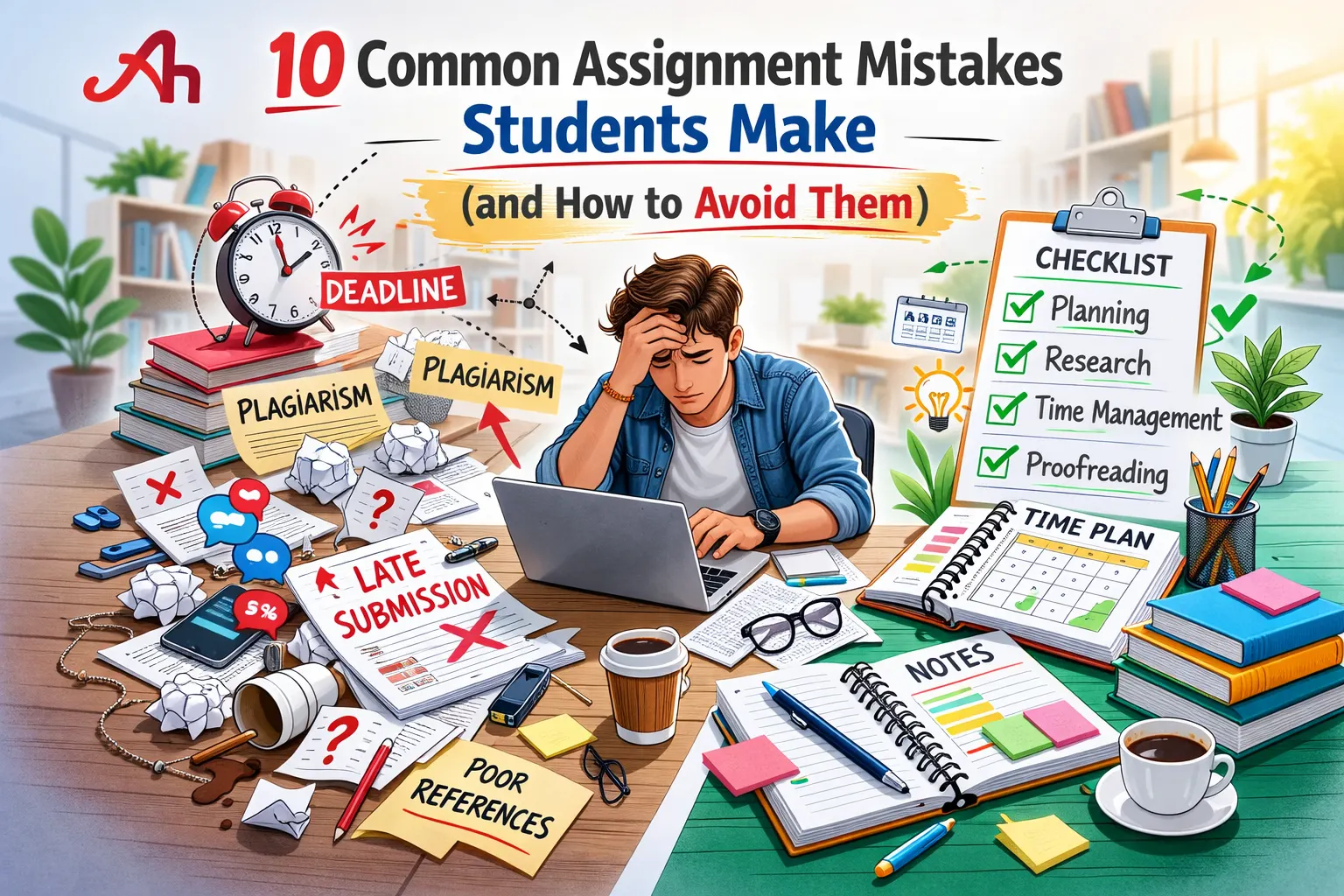
Every student has submitted an assignment and later realised a mistake that cost them marks. Whether you are writing a short essay or a long project, avoiding common assignment errors is the fastest way to improve your grades. If you ever feel stuck or confused, professional assignment help services are always available to guide you. This blog covers the 10 most common assignment mistakes students make and exactly how to fix them with proven assignment writing tips.
Why Assignment Mistakes Matter More Than You Think
Making repeated academic writing mistakes does not just lower your grades — it affects your confidence and your overall academic record. The good news is that almost all of these mistakes are avoidable once you know what to look for.
1. Not Reading the Assignment Brief Properly
This is one of the most common and damaging assignment mistakes students make. Many students start writing without fully understanding what the question is asking.
How to Avoid It
Read the brief carefully at least two to three times before you begin.
Underline key instruction words like analyse, discuss, compare, or evaluate.
Note all requirements — word count, format, referencing style, and deadline.
If you are unsure about anything, ask your tutor or get homework help before you start writing.
2. Starting Without a Plan or Outline
Writing without a plan is one of the classic academic writing mistakes. Without a clear structure, your assignment will feel scattered and hard to follow.
How to Avoid It
Spend some time planning before you write — even a simple bullet-point outline helps.
Decide what each section will cover and what evidence you will use.
For big projects like dissertation help or thesis help, a proper chapter outline is essential.
A clear plan saves you time and keeps your writing focused throughout.
3. Writing a Weak or Unclear Thesis Statement
A thesis statement tells the reader what your assignment is arguing. Without a clear one, your essay has no direction — this is a very common essay writing problem.
How to Avoid It
Write your thesis statement at the end of your introduction.
It should be one or two sentences that clearly state your main argument.
Avoid vague openers like "This essay will talk about..." — be direct and specific.
Check your thesis again after finishing your draft to make sure your writing still supports it.
4. Using Too Many Quotes
Filling your assignment with too many quotes is a sign that you are not analysing the content yourself. Markers want to see your own thinking, not just copied text from sources.
How to Avoid It
Use direct quotes only when the exact wording is important.
Paraphrase most of your sources and cite them properly.
After every quote or paraphrase, explain what it means and why it matters.
A good balance is roughly 80% your own words and 20% source material.
5. Wrong Referencing and Citation Errors
Incorrect referencing is one of the most penalised common assignment errors in universities. It can even lead to academic misconduct issues if not handled carefully.
How to Avoid It
Find out which referencing style is required — APA, Harvard, MLA, or Chicago — and use it throughout.
Use free tools like Zotero or Cite This For Me to format citations correctly.
Before submitting, check that every in-text citation matches your reference list.
Students working on research paper writing need to be especially careful about citing sources correctly.
6. Plagiarism — Even When Accidental
Plagiarism is one of the most serious assignment mistakes you can make. Even if you did not mean to copy, forgetting to cite a source can still get you in trouble.
How to Avoid It
Keep a record of every source you use while researching — do not leave it for later.
Run your assignment through a plagiarism checker like Turnitin or Grammarly before submitting.
Always cite any idea, fact, or argument that came from another person's work.
For complex tasks like a case study or coursework help, use legitimate academic support services.
7. Going Over or Under the Word Count
Many students do not pay close attention to the word count. Going significantly over or under the limit is an easily avoidable academic writing mistake that affects your marks.
How to Avoid It
Before writing, plan how many words each section should have.
Check your word count regularly while writing — not just at the end.
If you are over the limit, cut unnecessary words, repetition, and filler phrases.
If you are under the limit, add more analysis, examples, or explanation to your key points.
8. Poor Paragraph Structure and Weak Flow
Many students write paragraphs that jump between ideas without any clear connection. This makes the assignment confusing and hard to follow.
How to Avoid It
Use the PEEL method for each paragraph: Point, Evidence, Explanation, Link.
Each paragraph should focus on one idea only — if you have two ideas, use two paragraphs.
Use linking words and phrases between paragraphs to create smooth flow.
This method works especially well for management help and marketing help assignments.
9. Skipping Proofreading Before Submission
Submitting without proofreading is one of the simplest assignment mistakes to avoid, yet so many students do it. Small errors in spelling and grammar can cost you marks.
How to Avoid It
Finish your draft a few hours before the deadline so you can proofread with fresh eyes.
Read your assignment out loud — this helps you catch awkward sentences and errors.
Use Grammarly for a quick grammar check, then do your own read-through as well.
For assignments requiring precise language — like a nursing assignment — careful proofreading is especially important.
10. Leaving Everything to the Last Minute
Procrastination is behind most poor assignments. When you rush at the last minute, you skip planning, research, and editing — all the things that make a good assignment.
How to Avoid It
Break your assignment into small steps as soon as you receive it: research, outline, draft, edit, proofread.
Set your own internal deadline at least two days before the real one.
Work for 25 minutes, then take a 5-minute break — this keeps you productive without burning out.
If you are overwhelmed, use a trusted student assignment help service to get back on track.
Quick Checklist Before You Submit Any Assignment
Use this simple checklist every time to avoid the most common assignment writing tips violations:
Content and Argument
Have you answered the exact question asked?
Is your thesis statement clear in the introduction?
Does every paragraph support your main argument?
Structure and Format
Does your assignment have an introduction, body, and conclusion?
Is the formatting correct as per the brief?
Is your word count within the required range?
Referencing and Plagiarism
Are all citations formatted in the correct style?
Does every in-text citation appear in your reference list?
Have you run a plagiarism check?
Language and Presentation
Have you checked spelling, grammar, and punctuation?
Is your language formal and academic throughout?
Have you removed any casual or informal phrases?
Conclusion
Avoiding assignment mistakes is not about being perfect — it is about building better habits. Every mistake covered in this blog can be fixed with a little planning and awareness. Start applying these assignment writing tips one at a time and you will notice a real difference in your grades. Plan before you write, cite as you go, and always leave time to proofread before submitting. Small, consistent improvements in your academic writing add up to big results over a semester. And if you ever feel stuck or overwhelmed, professional student assignment help is always available to support you.