
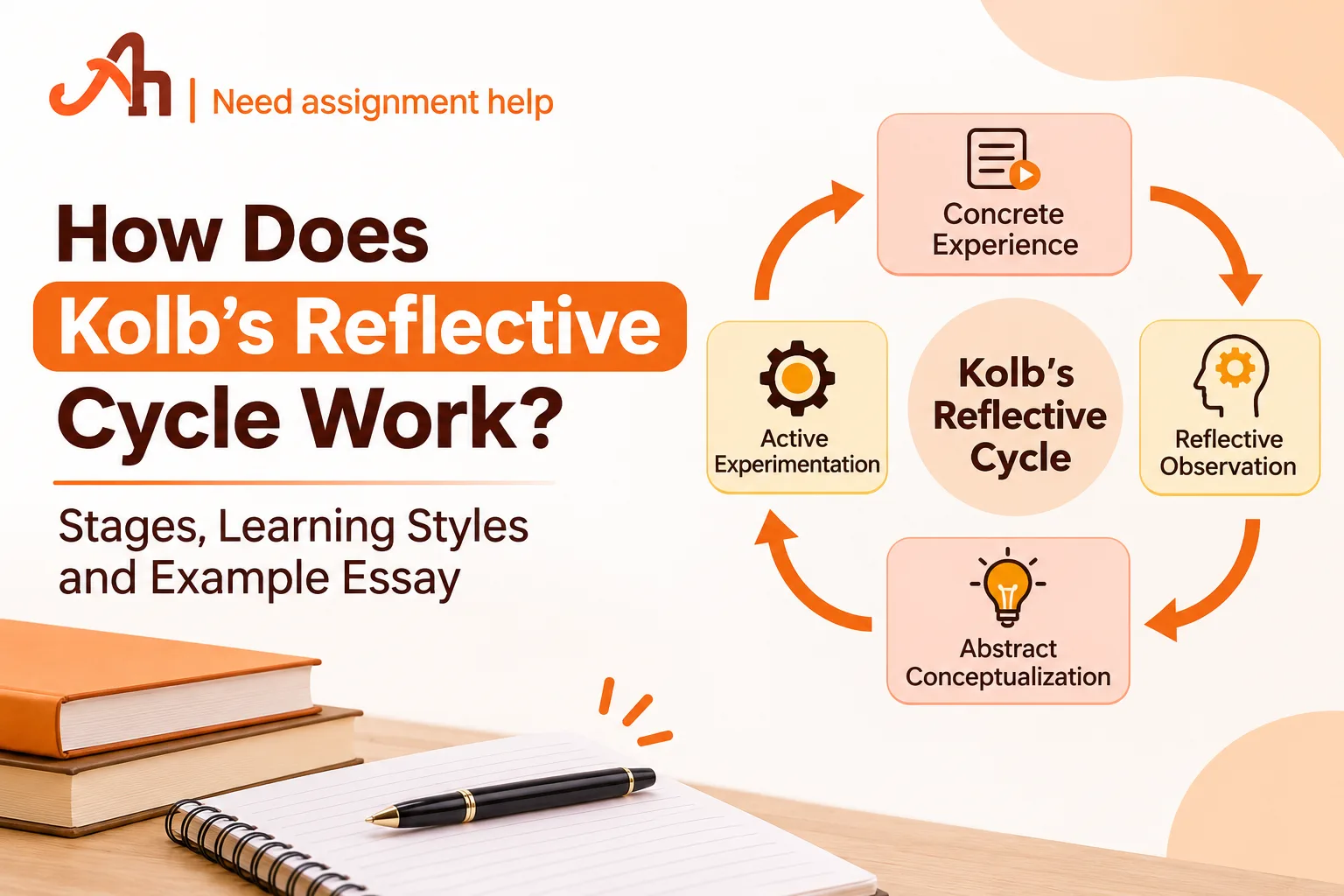
Kolb's Reflective Cycle is a four-stage model that explains how people learn from experience: Concrete Experience, Reflective Observation, Abstract Conceptualisation and Active Experimentation. Developed by educational theorist David A. Kolb in 1984, it turns everyday experiences into lasting knowledge. If your tutor has asked you to write a reflective essay, a placement journal or a learning portfolio, this model is one of the most widely accepted frameworks you can use.
This guide explains the four stages, the four learning styles, how to apply the cycle step by step, and how it differs from Gibbs' cycle. It ends with a complete example essay you can use as a structural guide. If you want expert support at any point, our team offers assignment help across hundreds of subjects.
Quick Answer: What Is Kolb's Reflective Cycle?
Kolb's Reflective Cycle (also called Kolb's Experiential Learning Cycle) describes learning as a continuous loop in which you do something, reflect on it, form theories, and test those theories in new situations.
Created by: David A. Kolb (1984), building on earlier work with Roger Fry
Core idea: Learning is not just absorbing information; it is created through experience
Number of stages: 4
Number of learning styles: 4 (Diverging, Assimilating, Converging, Accommodating)
Best used for: Reflective essays, placement logs, group-work reviews, professional development and teaching design
Why Students Search for Kolb's Reflective Cycle
Students usually look up this model for three reasons:
Reflective writing: Many courses ask you to describe an experience and analyse what you learned from it.
Theory application: Tutors expect you to connect personal experience with an academic framework, not just narrate events.
Marks: A clear structure is easy for markers to follow, which often improves grades.
The model suits nursing, psychology, teaching, management and health and social care students because those courses rely heavily on practice-based learning.
The Background of Kolb's Experiential Learning Theory
Who Was David Kolb?
David A. Kolb is an American educational theorist. His 1984 book Experiential Learning: Experience as the Source of Learning and Development set out the theory. He drew on the ideas of John Dewey, Kurt Lewin and Jean Piaget, all of whom argued that learning is an active process.
What Does "Experiential Learning" Mean?
Experiential learning means learning by doing and then thinking about what was done. Reading a textbook on leadership is one kind of learning. Leading a team project and then reviewing what worked is experiential learning, and Kolb argued it produces deeper understanding.
Why Is It Called a "Reflective" Cycle?
The words "reflective cycle" and "experiential learning cycle" are often used interchangeably. The model is a cycle because the end of one round becomes the start of the next. It is reflective because Stage 2 forces you to step back and examine what happened.
The Four Stages of Kolb's Reflective Cycle
The four stages are Concrete Experience, Reflective Observation, Abstract Conceptualisation and Active Experimentation, and they repeat in a loop. Learning is considered complete only when you have moved through all four.
Stage 1: Concrete Experience (Doing)
Concrete Experience is the stage where you directly take part in an activity or encounter something new. It can be a lab session, a clinical placement, a presentation, a team meeting or a failed exam.
Describe what happened, where and with whom
Note your feelings in the moment
Keep it factual and avoid early judgement
Student example: Delivering a group presentation that overran its time limit.
Stage 2: Reflective Observation (Reviewing)
Reflective Observation means stepping back to review the experience from different angles. You ask what went well, what went wrong and why.
Compare your view with feedback from peers or tutors
Look for gaps between what you expected and what actually happened
Identify patterns, not just single incidents
Student example: Noticing that the group never agreed on roles before preparing slides.
Stage 3: Abstract Conceptualisation (Thinking)
Abstract Conceptualisation is where you connect your reflections to theories, models and research. This is the stage that separates academic reflection from a diary entry.
Link your experience to relevant concepts, such as team-development models in organizational behavior or communication theories
Form general principles ("clear role allocation reduces conflict")
Support your ideas with scholarly sources and correct referencing
Stage 4: Active Experimentation (Applying)
Active Experimentation means testing your new understanding in a real situation. It closes the loop and creates a fresh experience for the next cycle.
Write specific actions, not vague intentions
Set a measurable target ("assign roles in the first ten minutes of every meeting")
Plan how you will evaluate whether the change worked
How the Two Axes Shape the Cycle
Kolb arranged the four stages on two crossing axes, which is why the model is often drawn as a grid.
The Processing Continuum (How We Approach a Task)
Active Experimentation (Doing) at one end
Reflective Observation (Watching) at the other
The Perception Continuum (How We Take in Information)
Concrete Experience (Feeling) at one end
Abstract Conceptualisation (Thinking) at the other
Where you naturally sit on each axis determines your preferred learning style.
Kolb's Four Learning Styles Explained
Kolb's learning styles are Diverging, Assimilating, Converging and Accommodating, and each one combines a preference for two adjacent stages of the cycle. They describe how you tend to learn, not how well you learn.
Kolb's Learning Styles at a Glance
Diverging Style (Feeling and Watching)
Divergers prefer to observe rather than act. They collect information from many perspectives and generate lots of ideas.
Often found in: Arts, counselling, human resource management, public relations
Learn best through: Group discussion, case discussions, open brainstorming
Watch out for: Difficulty making quick decisions
Assimilating Style (Watching and Thinking)
Assimilators like clear logic and well-organised information. They care more about whether an idea is sound than whether it is immediately useful.
Often found in: Research, mathematics, economics, data science
Learn best through: Lectures, readings, models and case analysis
Watch out for: Overthinking before taking action
Converging Style (Thinking and Doing)
Convergers turn ideas into solutions. They prefer technical tasks to interpersonal ones.
Often found in: Engineering, computer science, programming
Learn best through: Experiments, simulations, practical problem sets
Watch out for: Rushing to one answer too early
Accommodating Style (Doing and Feeling)
Accommodators learn by trying things and adapting on the go. They rely on instinct and other people's input more than on analysis.
Often found in: Sales, marketing, project management, nursing practice
Learn best through: Fieldwork, placements, role-play
Watch out for: Acting without a clear plan
Can Your Learning Style Change?
Yes. Kolb stressed that styles are preferences, not fixed labels. Most people use all four modes depending on the task, and effective learners deliberately strengthen the stages they usually skip.
How to Use Kolb's Reflective Cycle: Step-by-Step
To apply Kolb's cycle, describe an experience, reflect on it, connect it to theory, then plan and test a specific change. Follow these steps for any reflective task.
Choose one clear experience. Pick a single event, not a whole semester.
Describe it objectively. Cover what happened, who was involved and what the outcome was.
Reflect honestly. Explore your thoughts, feelings, mistakes and successes.
Find a relevant theory. Match your situation with a framework or journal article.
Draw conclusions. State what the theory reveals about your experience.
Plan an action. Say exactly what you will do differently next time.
Test and review. Describe how you will measure the result, which restarts the cycle.
How to Write a Reflective Essay Using Kolb's Cycle
Recommended Essay Structure
Introduction: State the experience, the purpose of your reflection and your use of Kolb's model
Body 1, Concrete Experience: Describe the event
Body 2, Reflective Observation: Analyse your thoughts, reactions and feedback
Body 3, Abstract Conceptualisation: Apply theory and scholarly evidence
Body 4, Active Experimentation: Present your action plan
Conclusion: Summarise the main lesson and how the cycle will continue
Writing Tips That Improve Marks
Use the first person unless your tutor says otherwise
Balance description with analysis (aim for roughly 30% description, 70% analysis)
Back up claims with academic sources, not just opinion
Keep your action plan specific and realistic
Proofread carefully, because small errors weaken a reflective voice
If you are short on time, our essay writing service and proofreading help can polish your draft before submission.
Example Essay: Kolb's Reflective Cycle in Practice
The sample below shows how the four stages fit into a short reflective essay. It is written as a student reflecting on a group project.
Sample Title: Reflecting on a Group Presentation Using Kolb's Reflective Cycle
Introduction
Reflection helps students turn practice into learning. This essay uses Kolb's (1984) Reflective Cycle to examine a group presentation I delivered during my second year of a business degree. The model's four stages guide the structure below.
Concrete Experience
Our group of four was asked to present a market-entry strategy in twelve minutes. We divided the slides informally and rehearsed only once. On the day, the first speaker spent six minutes on background, leaving the rest of us rushed. We finished late, and the tutor interrupted before our recommendations. I felt anxious and embarrassed, and I was frustrated that we had not prepared more carefully.
Reflective Observation
Looking back, the problem was not a lack of knowledge. We had researched well, but we never agreed on timing or roles. I assumed someone else would manage the clock, and so did everyone else. Peer feedback confirmed this: classmates said our content was strong but our delivery felt disorganised. I also noticed that I tend to avoid conflict, so I did not challenge the plan when I had doubts.
Abstract Conceptualisation
Team-development theory suggests groups often struggle in early stages without clear norms and defined roles (Tuckman, 1965). Our group skipped the "norming" stage altogether. Research on team roles also shows that explicit role allocation reduces duplication and confusion (Belbin, 1981). My avoidance of conflict reflects a passive communication pattern, which can reduce a team's ability to correct errors. These ideas explain why our presentation felt rushed despite good research.
Active Experimentation
In future group tasks, I will take three actions. First, I will propose roles, including a timekeeper, in the first meeting. Second, I will request at least two timed rehearsals before any assessment. Third, I will practise raising concerns early with a short, neutral statement such as "Can we check the timing for this section?" I will test these actions in my next team project and review the results with peer feedback afterwards.
Conclusion
Kolb's cycle showed me that a poor outcome is useful data. By moving from experience to reflection, theory and planned action, I identified practical changes rather than simply blaming nerves. The cycle will continue as I apply these steps and reflect again.
Note: This sample is for guidance only. Use your own experience and sources, and always follow your institution's referencing rules.
To see how professional work is structured, browse our assignment samples.
Kolb's Reflective Cycle vs Gibbs' Reflective Cycle
Kolb's cycle explains how learning develops over time, while Gibbs' cycle gives a more detailed structure for reflecting on one specific event. Students are often asked to choose between them.
Which should you choose? Pick Kolb if your task asks you to link experience with theory or discuss learning styles. Pick Gibbs if you need a detailed, step-by-step account of a single incident. Check your marking criteria first, because some courses specify the model.
Strengths of Kolb's Reflective Cycle
Simple and memorable: Four clear stages are easy to apply and explain
Flexible: Works in education, healthcare, business and personal development
Theory-linked: Encourages the move from description to analysis
Action-oriented: Ends with a plan, which markers value
Continuous: Supports lifelong learning rather than one-off reflection
Criticisms and Limitations You Should Mention
A strong essay shows critical thinking. Acknowledging limitations can raise your grade.
Learning styles evidence: Researchers have questioned whether matching teaching to a learner's "style" improves results, and the reliability of the Learning Style Inventory has been debated
Oversimplification: Real learning is rarely a neat four-step loop
Limited attention to context: The model gives little weight to culture, power and social setting
Reflection depth: Learners may stay at surface description without real analysis
Entry point: People do not always begin at Stage 1
Tip for essays: Use the cycle as a flexible guide, and state that learners often use several stages at once.
Where Students Use Kolb's Reflective Cycle
Kolb's model appears in many disciplines, which makes it a useful tool across your degree.
Nursing and healthcare: Reviewing patient interactions in nursing case studies and placement logs
Education: Planning lessons and reviewing teaching practice, relevant to early childhood education
Business and HR: Leadership development, training design and change management
Psychology and social science: Reflecting on research methods and fieldwork
Engineering and IT: Reviewing lab work, design projects and software Engineering sprints
For longer projects, a reflective chapter in a dissertation or thesis often uses Kolb to evaluate the research process.
Common Mistakes to Avoid
Writing a story, not an analysis: Too much description and too little theory lowers marks
Skipping Stage 3: No theory means no academic depth
Weak action plans: "I will try harder" is not a plan
Ignoring the learning styles: If asked, state your style and explain it with evidence from your own experience
Copying sample essays: Markers and software detect it, so run a plagiarism check before submitting
Inconsistent citations: Use one style throughout; our referencing help covers Harvard, APA, MLA, Chicago and more
Quick Revision Checklist
Before you submit your Kolb-based essay, confirm that:
You described one clear, specific experience
You reflected on thoughts, feelings and feedback
You linked your reflection to at least two scholarly sources
You wrote a measurable action plan
You mentioned at least one limitation of the model
You followed the required word count and referencing style
Need Help With Your Reflective Assignment?
Writing reflectively is hard when you are juggling deadlines, placements and exams. At Need Assignment Help, subject experts can guide you with:
Reflective essay writing based on Kolb, Gibbs or Schön
Coursework help for portfolios and reflective journals
University assignment help tailored to your marking rubric
Case study help for practice-based scenarios
- Research paper writing and academic report writing
Ready to start? Place your order and get original, referenced work delivered on time.
Conclusion
Kolb's Reflective Cycle gives students a clear route from experience to knowledge: do, reflect, conceptualise and apply. Its four learning styles show why people learn differently, and its action-focused ending helps you write reflections that earn marks. Use the stages as a structure, back every claim with theory, and acknowledge the model's limits to show critical thinking. Apply the cycle to your next essay or placement log, and your reflections will become sharper, more analytical and more convincing.
Frequently Asked Questions
Q. What are the four stages of Kolb's Reflective Cycle?
The four stages are Concrete Experience (doing), Reflective Observation (reviewing), Abstract Conceptualisation (thinking and theorising) and Active Experimentation (applying). They form a continuous loop, so the outcome of testing a new idea becomes the next concrete experience.
Q. What are Kolb's four learning styles?
Kolb's learning styles are Diverging (feeling and watching), Assimilating (watching and thinking), Converging (thinking and doing) and Accommodating (doing and feeling). Each style reflects a learner's preference for two adjacent stages, and most people use all four to some degree.
Q. How do I write a reflective essay using Kolb's cycle?
Start with a short introduction, then dedicate one section to each stage. Describe the experience, analyse your reactions, link them to academic theory and finish with a specific action plan. Add a conclusion summarising what you learned. For personalised support, try our reflective essay writing help.
Q. What is the difference between Kolb's and Gibbs' reflective cycles?
Kolb's model has four stages and focuses on how learning develops, including learning styles. Gibbs' model has six stages and gives a detailed structure for reflecting on a single event, with a dedicated stage for feelings. Choose based on your assignment brief.
Q. What are the main criticisms of Kolb's Reflective Cycle?
Critics argue the model oversimplifies learning, offers limited evidence that teaching to a preferred style improves results, questions the reliability of the Learning Style Inventory, and pays little attention to social and cultural context. Mentioning these points in your essay demonstrates critical thinking.