
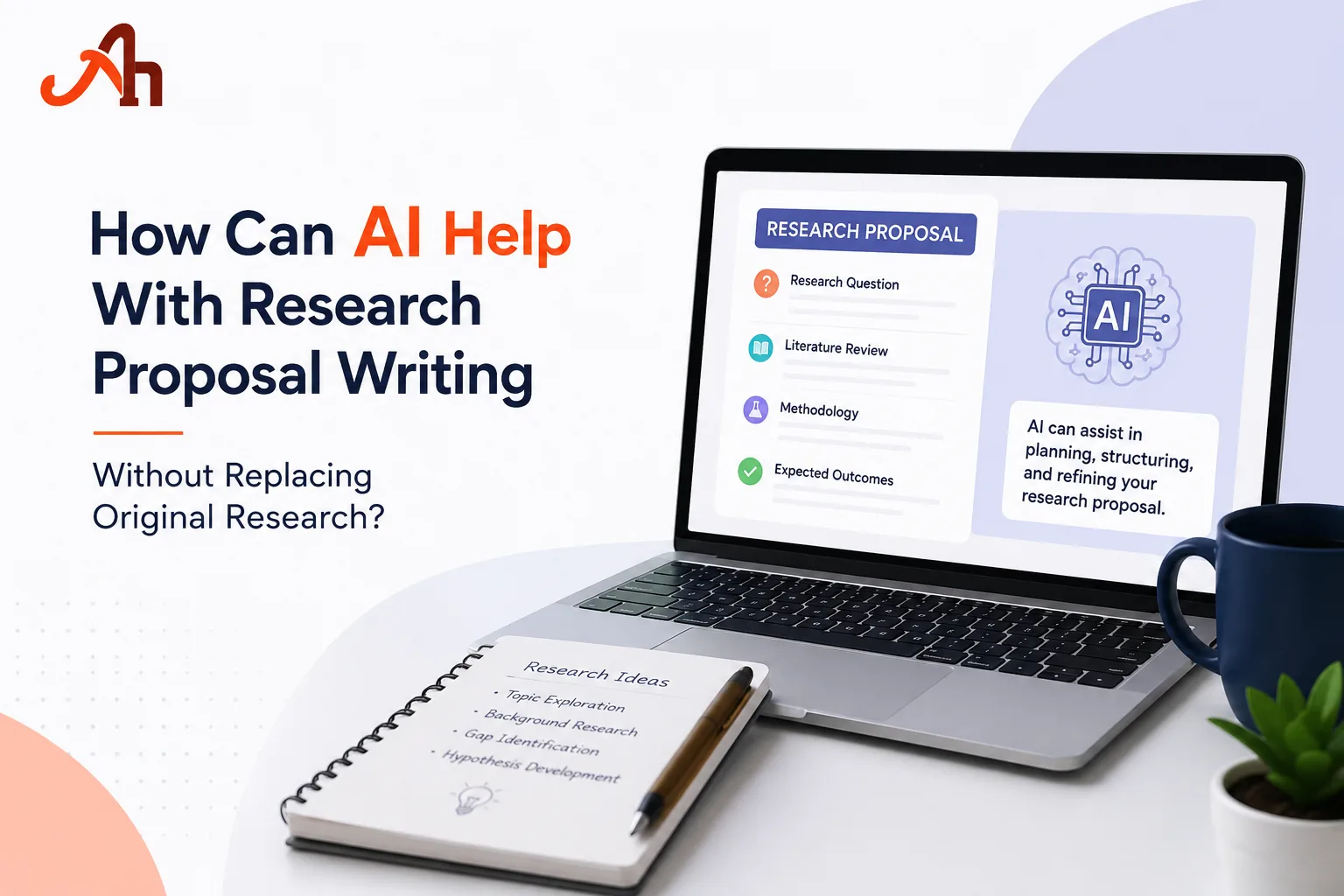
Staring at a blank page while your research proposal deadline creeps closer is one of the most stressful parts of student life. AI tools can genuinely speed up brainstorming, structuring, and editing — but they cannot replace the original thinking, data, and argument that make a proposal yours. This guide shows exactly where AI helps, where it hurts, and how to use it responsibly for research proposal writing.
What Is AI's Real Role in Research Proposal Writing?
Used this way, AI functions closer to a study partner than a substitute researcher. It helps you organize thoughts faster and catch weak spots in your logic, but the intellectual contribution — your hypothesis, your gap in the literature, your methodology choice — still has to come from you.
Why Students Are Turning to AI for Research Proposals
AI adoption in academic writing has moved from experimental to mainstream. By early 2026, an estimated 86% of higher-education students use AI as a primary research and brainstorming partner, and global student AI usage jumped from 66% in 2024 to 92% in 2025, according to education-technology usage data. Among researchers specifically, roughly 41% report using AI tools to help draft grant or research proposals.
Fast Facts: AI in Academic Writing (2026)
- 86% of higher-ed students now use AI as a primary research/brainstorming tool
- 41% of researchers use AI to help draft grant or research proposals
- 48% of graduate students use AI during literature reviews for synthesis, not sentence-writing
- 63% of students still say submitting AI-written work as your own is cheating
That last figure matters most. Students themselves increasingly see a line between using AI and outsourcing their research to it — and universities are drawing that same line in their academic integrity policies.
How AI Can Genuinely Help With Research Proposal Writing
When used within limits, AI can meaningfully reduce the friction of writing a research proposal. Here's where it earns its place in your workflow.
1. Brainstorming and Topic Refinement
AI is strongest at the very first stage: turning a vague interest into a workable, arguable research question. You can ask it to suggest angles, narrow an overly broad topic, or stress-test whether your question is specific enough for the scope of your program.
2. Structuring the Proposal
Every research proposal follows a fairly standard skeleton — introduction, problem statement, objectives, literature review, methodology, timeline, and references. AI is efficient at generating this scaffolding so you can focus your energy on the content that actually needs original thought.
3. Literature Search Assistance
Tools built specifically for research, such as Elicit and Consensus, can help surface relevant papers and summarize findings faster than manual database searching. This speeds up discovery, but every source still needs to be opened and verified by you before it goes into your proposal.
4. Language, Grammar, and Clarity
AI-powered editors are reliable for catching grammar slips, awkward phrasing, and inconsistent academic tone — especially useful for multilingual and international students who want their proposal to read fluently without changing its meaning.
5. Formatting and Referencing Support
AI can help format a document to APA, MLA, Harvard, or Chicago style guidelines and flag missing in-text citations. It's a useful first pass — but referencing accuracy still needs a manual check, which brings us to the biggest risk.
Where AI Falls Short — and Why Original Research Still Matters
The single biggest danger in AI-assisted research writing is fabricated, or "hallucinated," citations — references to studies that sound real but do not exist.
⚠ The Citation Hallucination Problem
A Columbia University audit published in The Lancet in May 2026 scanned 2.5 million papers and found fabricated citations had surged 12-fold since 2023. By early 2026, roughly 1 in every 277 papers contained at least one non-existent reference, up from 1 in 2,828 in 2023. General-purpose chatbots have also been shown to carry citation hallucination rates as high as 40–70% when generating references from memory.
This is exactly why original research cannot be delegated to AI. A machine-generated proposal built on invented studies doesn't just risk a poor grade — it risks academic misconduct flags and a methodology built on nothing. Beyond citations, AI also falls short in these areas:
- Original data and fieldwork — AI cannot run your surveys, interviews, or experiments
- Discipline-specific judgment — it doesn't know your professor's expectations or your program's methodology norms
- Up-to-date scholarship — only 55% of researchers believe AI tools reflect the most current scholarly literature
- Ethical accountability — you, not the AI, are accountable for every claim in your proposal
- Genuine argument ownership — a proposal is meant to demonstrate that you can think like a researcher, not that a chatbot can
How to Use AI Without Compromising Academic Integrity
Used carefully, AI can support your workflow without crossing into misconduct. Follow this sequence:
- Start with your own question. Decide your research problem before opening any AI tool.
- Use AI for structure, not substance. Let it suggest an outline; you fill in the argument.
- Verify every citation manually. Search each reference in Google Scholar or your university database before including it.
- Run AI drafts through your own analysis. Rewrite AI suggestions in your voice and check them against your course readings.
- Check your institution's AI policy. Disclosure requirements vary widely by university and even by course.
- Keep a research trail. Save your notes, search history, and drafts to show authentic development of ideas.
AI Assistance vs. Human Academic Support: Quick Comparison
| Task | AI Tools | Human Academic Expert |
|---|---|---|
| Brainstorming topics | Fast, broad suggestions | Tailored to your program and interests |
| Literature review depth | Surface-level summaries | Critical, discipline-specific analysis |
| Citation accuracy | Prone to fabricated references | Verified, correctly formatted sources |
| Methodology design | Generic templates | Aligned to your research question and field |
| Feedback & revision | Rule-based edits | Contextual, supervisor-style feedback |
When You Need More Than AI: Expert Research Proposal Help
AI is a useful assistant, but it isn't a substitute for subject-matter expertise, especially when your proposal needs a methodology that fits your discipline or citations that will actually hold up under review. If you want your research question, structure, and referencing checked by a qualified academic writer, Need Assignment Help's research proposal writing help service pairs you with subject specialists who refine your original ideas rather than replace them.
The same principle applies across other academic writing tasks. Whether you need support with a research paper, a full dissertation, a thesis, an annotated bibliography, or simply want your draft checked through proofreading help and a plagiarism check, expert review keeps AI-assisted drafts within academic integrity boundaries.
This same AI-plus-expert balance carries over into everyday coursework too. Students juggling multiple deadlines often pair AI brainstorming with proper assignment help, homework help, coursework help, and case study help from subject specialists, along with referencing help and university assignment help to keep formatting and citations accurate. For a broader piece of writing beyond the proposal itself, essay writing support and college essay writing help follow the same integrity-first approach.
This applies whatever discipline your proposal sits in — from nursing assignment help and law assignment help to business assignment help, management assignment help, computer science assignment help, and engineering assignment help— a subject specialist keeps your original argument intact while AI simply speeds up the groundwork.
Related Reading
Working on a reflective assignment next? Read our companion guide: How to Write a Good Reflective Essay: Step-by-Step Guide for Students — or explore reflective essay writing help for one-on-one support.
Conclusion
AI can genuinely lighten the load of research proposal writing — from brainstorming a question to polishing grammar and formatting references. What it cannot do is replace the original thinking, verified sources, and academic judgment that make a proposal credible. Use AI as a structuring and editing partner, keep your research question and analysis your own, and verify every citation before submission. That balance is what keeps your proposal both efficient and academically sound.
Frequently Asked Questions
Q. Can I use AI to write my entire research proposal?
No. Using AI for your entire proposal risks fabricated citations and academic misconduct flags. Use it for structure and editing, not original content.
Q. Do universities allow AI tools for research proposals?
Policies vary by institution and course. Always check your university's AI disclosure guidelines before submitting AI-assisted work.
Q. Why does AI generate fake citations?
AI predicts plausible-sounding text rather than verifying facts, so it can invent references that look real but don't exist.
Q. Is it plagiarism to use AI for brainstorming only?
Generally no, since brainstorming shapes your thinking rather than replacing your writing. Still, disclose AI use if your institution requires it.
Q. How can I check if my AI-suggested sources are real?
Search each citation directly in Google Scholar or your library database to confirm the paper, authors, and publication actually exist.