
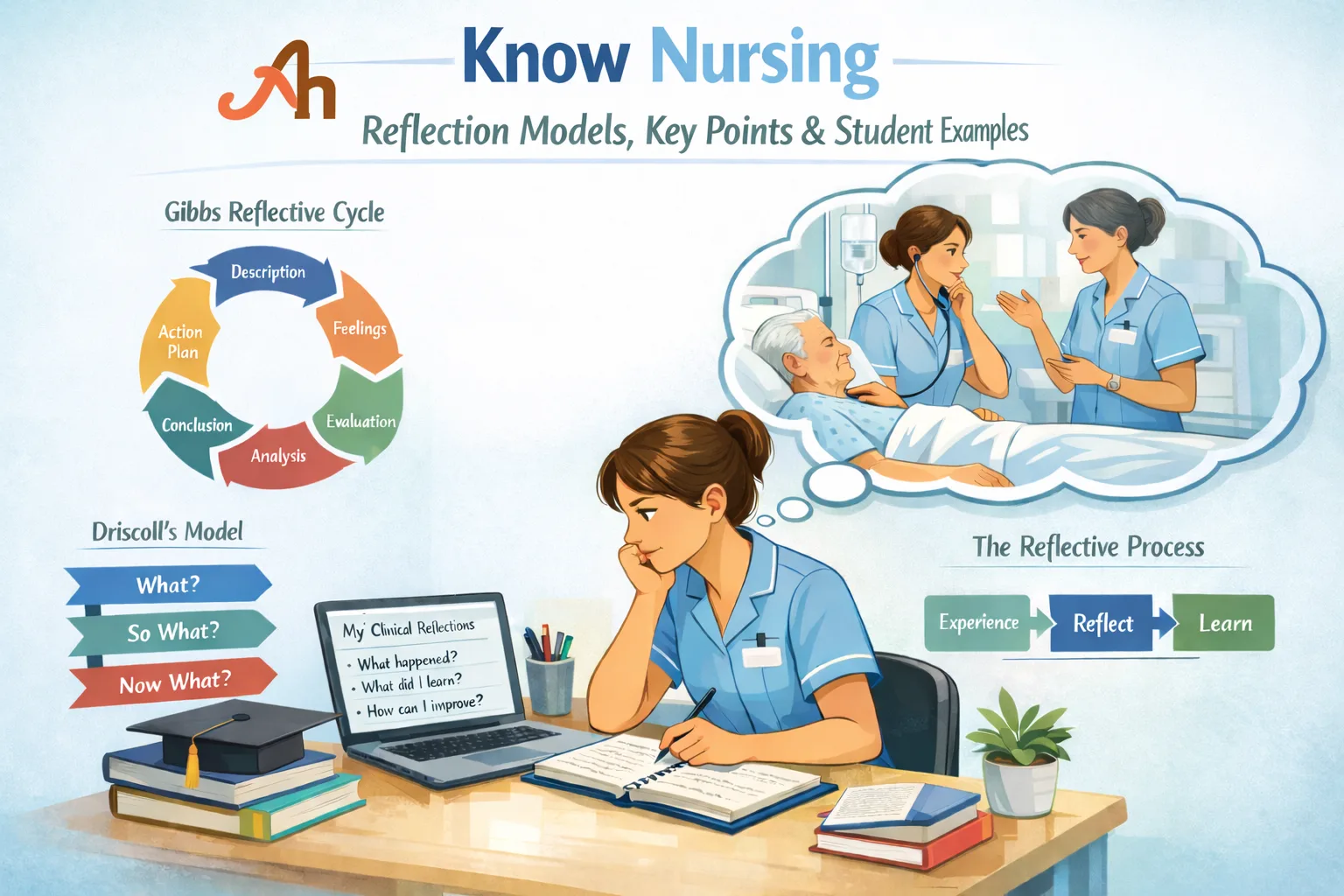
Nursing reflection is a critical skill that transforms everyday clinical experiences into powerful learning opportunities. Whether you are a first-year student or a practising nurse, understanding reflective practice helps you grow professionally and deliver better patient care. If you ever struggle with writing your nursing assignments, seeking reliable assignment help can give you the structured support you need to excel. This guide breaks down the top nursing reflection models, key takeaways, and real student examples so you can apply them with confidence.
What Is Nursing Reflection and Why Does It Matter?
Reflective practice in nursing is the deliberate process of thinking critically about clinical experiences to improve future performance. It is not merely recounting what happened — it is a structured analysis of actions, feelings, outcomes, and lessons learned. Regulatory bodies such as the Nursing and Midwifery Council (NMC) actively endorse reflection as a core professional requirement.
Nurses who reflect regularly tend to:
Improve clinical decision-making by identifying patterns across patient interactions
Build emotional resilience through honest examination of challenging moments
Enhance communication skills with patients, families, and multidisciplinary teams
Fulfil professional development requirements for revalidation and appraisal
Bridge the theory-practice gap by connecting academic learning to real-world scenarios
Top Nursing Reflection Models Every Student Must Know
Several structured nursing reflection models guide the reflective writing process. Each model offers a different lens through which nurses can analyse their experiences. Here are the three most widely used frameworks.
1. Gibbs Reflective Cycle (1988)
Developed by Graham Gibbs, the Gibbs reflective cycle is arguably the most popular model used in nursing education. Its six-stage cyclical structure makes it highly accessible for students writing their first reflective accounts.
The Six Stages of Gibbs Reflective Cycle
Stage 1 – Description: What happened? Provide a clear, objective account of the event without judgement.
Stage 2 – Feelings: What were you thinking and feeling during and after the experience?
Stage 3 – Evaluation: What was good and what was bad about the experience?
Stage 4 – Analysis: What sense can you make of the situation? Use nursing theory to support your thinking.
Stage 5 – Conclusion: What else could you have done? What have you learned?
Stage 6 – Action Plan: If the situation arose again, what would you do differently?
Why Students Prefer Gibbs
The cyclical nature ensures learning is ongoing rather than one-off. It is especially effective for situations involving strong emotional responses — making it ideal for reflecting on patient communication, medication errors, or end-of-life care scenarios.
2. Johns' Model of Structured Reflection (1994)
Christopher Johns' model — commonly known as the Johns reflective model — draws on Carper's four ways of knowing: empirical, personal, ethical, and aesthetic. It is more nuanced than Gibbs and encourages deeper self-examination through guided cue questions.
Key Cue Questions in Johns' Model
Description: Describe the experience, including what you were trying to achieve and what actually happened.
Reflection: What internal factors — values, beliefs, emotions — influenced how you responded?
Influencing Factors: What external factors such as workload, environment, or team dynamics shaped your actions?
Alternative Actions: Could you have responded differently? What other options existed?
Learning: How has this experience changed your knowledge, attitudes, and nursing practice going forward?
Johns' model is particularly favoured in postgraduate nursing programmes and when reflecting on ethically complex situations such as informed consent, patient autonomy, or safeguarding dilemmas.
3. Rolfe's Reflective Model (2001)
The Rolfe reflective model — created by Gary Rolfe, Dawn Freshwater, and Melanie Jasper — is built on three deceptively simple questions. Its simplicity makes it an excellent starting point for students who are new to reflective writing or have limited word counts.
The Three-Question Framework
What? — Describe the situation, your role, and what happened objectively.
So What? — Analyse the significance of the event: how it made you feel, what theory relates to it, and what it means for your practice.
Now What? — Identify specific actions for future practice, development needs, and any changes required in your approach.
Rolfe's model is widely used in clinical supervision sessions, portfolio entries, and short reflective logs. Despite its brevity, each question opens rich layers of critical thinking when explored thoroughly.
Nursing Student Reflection Examples
Reading real nursing student reflection examples is one of the fastest ways to understand how these models work in practice. Below are concise but realistic illustrations for each framework.
Example 1 — Using Gibbs Reflective Cycle
Scenario: Medication Administration Delay
During my second clinical placement, I administered medication five minutes late due to a documentation misunderstanding. I felt anxious and embarrassed at the time. On evaluation, no patient harm occurred, but the delay highlighted a gap in my time-management skills. Analysing this against the NMC Code, I recognised that accurate and timely administration is non-negotiable in safe nursing practice. In future, I will double-check drug round schedules at the start of every shift and clarify any documentation uncertainty with my mentor immediately.
Example 2 — Using Johns' Reflective Model
Scenario: Breaking Bad News
I was present when a consultant informed a patient of a terminal diagnosis. I felt unprepared and uncertain about how to offer comfort. Internally, my lack of experience with end-of-life conversations influenced my silence. Externally, the fast-paced ward environment limited private time with the patient. I could have stayed beside the patient after the doctor left and offered reassurance. This experience has motivated me to seek palliative care communication training and practice supportive presence techniques.
Example 3 — Using Rolfe's Reflective Model
Scenario: Patient Falls Prevention
What? A patient fell while attempting to use the bathroom unsupported during my shift. So what? I had not re-assessed the patient's mobility risk after a change in medication the previous day. This connects directly to the importance of dynamic risk assessment in nursing theory and the NMC's guidance on patient safety. Now what? I will complete mobility re-assessments after any medication change, document updated risk scores immediately, and advocate for regular MDT discussions on at-risk patients.
Key Points for Effective Reflective Practice in Nursing
Understanding models is just the beginning. Here are the most important principles for strong reflective practice in nursing:
Be honest, not defensive — Reflection loses value when you avoid uncomfortable truths about your own practice.
Link theory to practice — Always connect your experience to nursing theory, evidence-based guidelines, or professional standards like the NMC Code.
Focus on learning, not blame — The goal of nursing reflection is growth, not self-punishment or assigning fault to others.
Maintain patient confidentiality — Always anonymise patient details in written reflections, replacing names with pseudonyms or general descriptors.
Write in the first person — Reflective writing is personal. Use "I" to own your thoughts, actions, and feelings authentically.
Review regularly — Reflection should be habitual, not reserved only for assignments or formal appraisals.
Common Mistakes Nursing Students Make in Reflections
Writing a narrative description without any analysis or reference to theory — this is storytelling, not reflection.
Using vague language like "it was a good experience" without unpacking why or how it was meaningful.
Ignoring the action plan stage — without a forward-looking commitment, the reflection is incomplete.
Failing to acknowledge negative emotions or mistakes out of fear of judgement from tutors or mentors.
Choosing the Right Nursing Reflection Model for Your Assignment
How to Match Model to Purpose
Gibbs Reflective Cycle → Best for emotionally loaded experiences, complex clinical events, or longer reflective essays (1,500–3,000 words).
Johns' Reflective Model → Ideal for ethical dilemmas, professional relationship challenges, or postgraduate reflections requiring deeper philosophical grounding.
Rolfe's Model → Perfect for quick portfolio entries, short clinical logs, or when your word count is limited (500–800 words).
Tips for Structuring Your Reflective Assignment
Pick one focused event rather than attempting to summarise your entire placement experience.
Cite peer-reviewed sources to support your analysis and action plan sections — journals like the Journal of Advanced Nursing are excellent starting points.
Anonymise all patient details before submission to meet ethical and data protection standards.
Draft, then revise — your first attempt at reflection rarely captures the full depth of your learning.
Reflective Practice Beyond Nursing — Related Academic Disciplines
Reflective writing skills are transferable across many academic disciplines. Students studying civil engineering and soft engineering use reflective frameworks in project post-mortems and design evaluations. Those working in economics and macroeconomics apply critical self-analysis when interpreting policy outcomes and economic models. Across professional programmes — including management assignment work, marketing assignment projects, and english assignment tasks — the ability to reflect critically elevates the quality of every academic submission.
Whether you need dissertation help, thesis help, homework help, or coursework help, the reflective thinking skills you develop in nursing directly strengthen your approach to essay writing, case study analysis, and research paper writing across every subject area.
Conclusion
Mastering nursing reflection is not just an academic exercise — it is a lifelong professional habit that shapes compassionate, evidence-based nursing practice. By understanding models like the Gibbs reflective cycle, the Johns reflective model, and the Rolfe reflective model, students gain clear frameworks to turn clinical experiences into meaningful growth. Apply these models consistently, connect your reflections to theory and professional standards, and embrace honest self-assessment. Your reflective practice today is the foundation of your excellence tomorrow.