
Cellular respiration is one of the most fundamental processes in biology, and every student studying life sciences must understand it thoroughly. Whether you are preparing for your board exams, college assignments, or simply trying to grasp how living organisms generate energy, this guide breaks it all down simply and clearly. If you ever need expert assignment help with complex biology topics like this, professional services are just a click away. This blog covers the cellular respiration equation, its stages, cycle, and complete process in an easy-to-follow format designed for students at every level.
What is Cellular Respiration? (Definition)
Cellular respiration is a set of metabolic reactions that take place in the cells of organisms to convert biochemical energy from nutrients — primarily glucose — into adenosine triphosphate (ATP), which is the usable energy currency of the cell. This process also releases carbon dioxide and water as by-products.
In simpler terms, it is how your body "burns" the food you eat to produce the energy needed for every biological function — from muscle movement to thinking and breathing.
The Cellular Respiration Equation
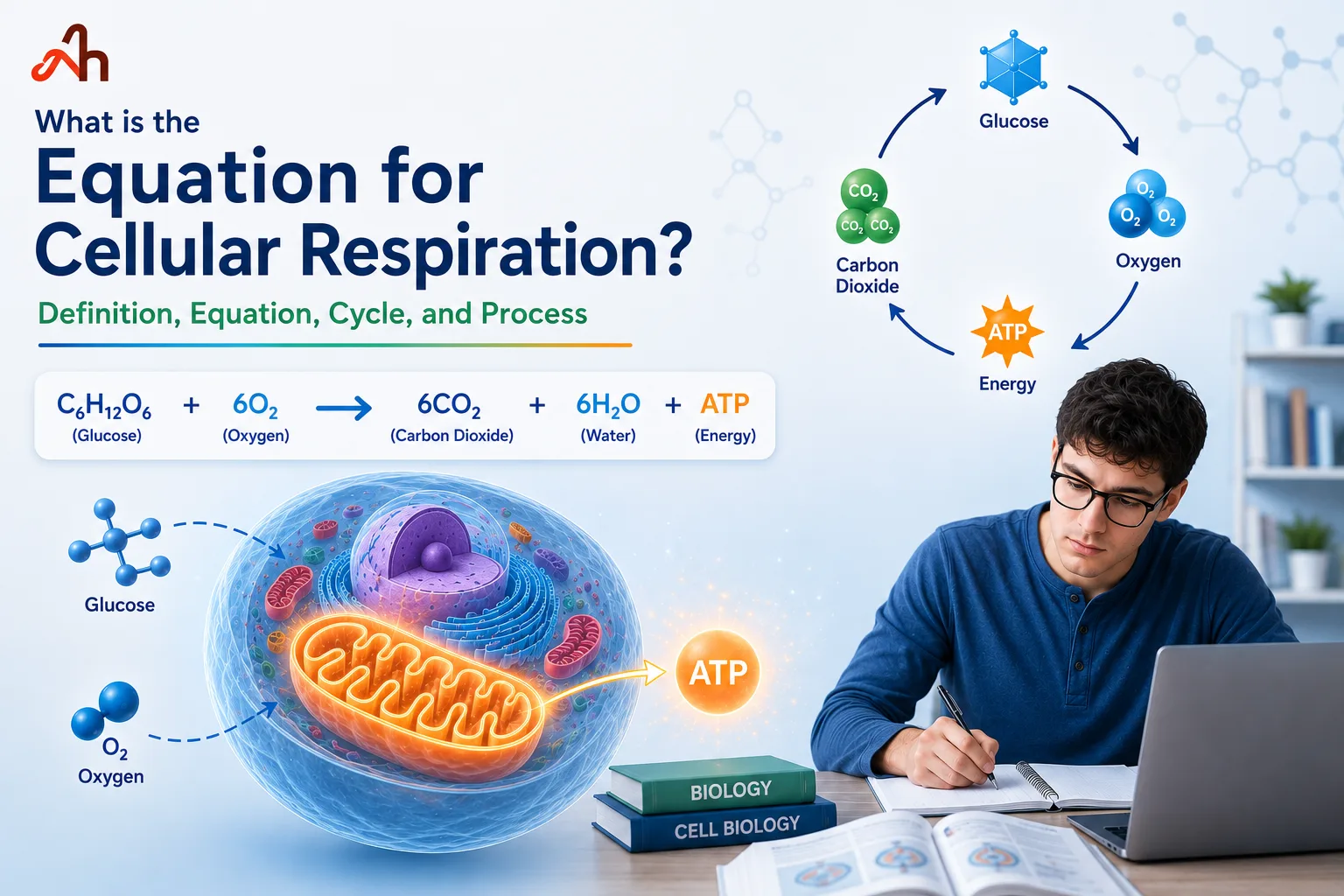
The overall cellular respiration equation (also called the equation of cellular respiration) summarises the entire process in one balanced chemical equation:
C₆H₁₂O₆ + 6O₂ → 6CO₂ + 6H₂O + ATP (Energy)
In words: One molecule of glucose plus six molecules of oxygen yields six molecules of carbon dioxide, six molecules of water, and energy in the form of ATP.
Breaking Down the Equation
C₆H₁₂O₆ — Glucose (the primary fuel source)
6O₂ — Six molecules of oxygen (required for aerobic respiration)
6CO₂ — Six molecules of carbon dioxide (expelled as waste)
6H₂O — Six molecules of water (released as by-product)
ATP — Adenosine Triphosphate (the energy produced and stored)
Aerobic Respiration Equation — What Makes It "Aerobic"?
The aerobic respiration equation is the same as the overall cellular respiration equation above because aerobic respiration is the most common and efficient form. The term "aerobic" simply means it requires oxygen.
Aerobic Respiration: C₆H₁₂O₆ + 6O₂ → 6CO₂ + 6H₂O + ~36–38 ATP
Aerobic respiration produces approximately 36 to 38 molecules of ATP per glucose molecule — making it far more efficient than anaerobic respiration, which produces only 2 ATP molecules.
Stages of Cellular Respiration
The cellular respiration process does not happen in a single step. It occurs in four major stages, each taking place in a specific part of the cell.
Stage 1: Glycolysis
Occurs in the cytoplasm of the cell
One glucose molecule (6 carbons) is split into two pyruvate molecules (3 carbons each)
Produces a net gain of 2 ATP and 2 NADH
Does not require oxygen — can occur under both aerobic and anaerobic conditions
Stage 2: Pyruvate Oxidation (Pyruvate Decarboxylation)
Occurs in the mitochondrial matrix
Each pyruvate is converted into Acetyl-CoA
Releases one CO₂ molecule per pyruvate
Produces 2 NADH (one per pyruvate)
Stage 3: Krebs Cycle (Citric Acid Cycle)
The cellular respiration cycle commonly refers to the Krebs Cycle (also known as the Citric Acid Cycle). It is one of the most important stages:
Occurs in the mitochondrial matrix
Acetyl-CoA enters and combines with oxaloacetate to form citric acid
The cycle turns twice per glucose molecule (once per pyruvate)
Produces 2 ATP, 6 NADH, 2 FADH₂, and releases 4 CO₂
Regenerates oxaloacetate to keep the cycle going
Why is it a "cycle"? Because the starting molecule (oxaloacetate) is regenerated at the end of each turn, allowing the process to continue repeatedly.
Stage 4: Oxidative Phosphorylation (Electron Transport Chain + Chemiosmosis)
Occurs on the inner mitochondrial membrane
NADH and FADH₂ donate electrons to the electron transport chain (ETC)
Oxygen acts as the final electron acceptor, forming water
A proton gradient drives ATP synthase to produce ATP (chemiosmosis)
This stage produces the majority of ATP — approximately 32–34 ATP molecules
ATP Production in Cells — Summary Table
Here is a quick-reference table showing ATP production in cells at each stage of cellular respiration:
The Cellular Respiration Cycle — A Closer Look
The term cellular respiration cycle usually refers specifically to the Krebs Cycle within the broader process. Here is how each revolution of the cycle unfolds:
Acetyl-CoA (2-carbon) combines with oxaloacetate (4-carbon) to form citrate (6-carbon)
Citrate is rearranged into isocitrate
Isocitrate is oxidised, releasing CO₂ and producing NADH → forms α-ketoglutarate
α-ketoglutarate loses CO₂ and is oxidised → forms succinyl-CoA and NADH
Succinyl-CoA converts to succinate, producing 1 ATP (or GTP)
Succinate is oxidised to fumarate → produces FADH₂
Fumarate becomes malate, then back to oxaloacetate → produces NADH
Oxaloacetate is now ready to accept another Acetyl-CoA — the cycle continues!
Cellular Respiration vs Photosynthesis — Key Differences
Cellular Respiration breaks down glucose to release energy (ATP) — occurs in all living cells
Photosynthesis builds glucose using sunlight — occurs only in plant cells and some bacteria
The two processes are complementary: the products of one are the reactants of the other
Respiration: C₆H₁₂O₆ + 6O₂ → 6CO₂ + 6H₂O + ATP
Photosynthesis: 6CO₂ + 6H₂O + Light → C₆H₁₂O₆ + 6O₂
Why Students Must Master Cellular Respiration
Cellular respiration appears across multiple academic disciplines — from high school biology to university-level biochemistry, medicine, and even sports science. Students working on assignments in subjects like medical assignment, statistics assignment, or even research paper writing may encounter data or concepts linked to energy metabolism.
Understanding this topic helps with:
Answering exam questions on ATP, metabolism, and mitochondria
Writing biology dissertations — see dissertation help for expert support
Understanding pharmacology, nutrition, and exercise science
Building a strong foundation for advanced studies in biochemistry and physiology
Common Misconceptions About Cellular Respiration
Misconception 1: Cellular Respiration Is the Same as Breathing
Breathing (ventilation) is simply the mechanical process of inhaling and exhaling air. Cellular respiration is the chemical process at the cellular level that actually uses that oxygen to produce ATP.
Misconception 2: Only Animals Undergo Cellular Respiration
All living organisms — plants, fungi, bacteria, and animals — perform cellular respiration. Even plants, which photosynthesise during the day, also carry out cellular respiration continuously.
Misconception 3: Mitochondria Are the Only Location
Glycolysis — the very first stage — occurs in the cytoplasm, not the mitochondria. Only the later stages (Krebs Cycle and Oxidative Phosphorylation) take place in the mitochondria.
Smart Tips to Remember the Cellular Respiration Equation
Tip 1 — Use a Mnemonic
Remember the stages as "Good Kings Play Chess On Fine Grounds" — Glycolysis, Krebs (Pyruvate), Citric acid, Oxidative phosphorylation, Fermentation (if anaerobic), Great ATP yield.
Tip 2 — Draw the Cycle
Sketch the Krebs Cycle with arrows and label inputs and outputs at each step. Visual learning dramatically improves retention of complex biochemical pathways.
Tip 3 — Use the Equation Daily
Write the equation — C₆H₁₂O₆ + 6O₂ → 6CO₂ + 6H₂O + ATP — at the top of each study session until it is second nature.
Bonus: Practice past exam questions
Search for past paper questions on cellular respiration to test your understanding. Practising with real exam scenarios is the most effective revision technique.
Frequently Asked Questions (FAQs) on Cellular Respiration
Q1. What is the overall equation for cellular respiration?
The overall cellular respiration equation is: C₆H₁₂O₆ + 6O₂ → 6CO₂ + 6H₂O + ATP (Energy). This represents the complete aerobic breakdown of one glucose molecule using six oxygen molecules to produce carbon dioxide, water, and usable energy.
Q2. How many ATP molecules are produced during cellular respiration?
Aerobic cellular respiration produces approximately 36 to 38 ATP molecules per glucose molecule. Glycolysis accounts for 2 ATP, the Krebs Cycle for 2 ATP, and the Electron Transport Chain (Oxidative Phosphorylation) for the remaining 32–34 ATP.
Q3. What are the four stages of cellular respiration?
The four stages are: (1) Glycolysis (cytoplasm), (2) Pyruvate Oxidation (mitochondrial matrix), (3) Krebs Cycle / Citric Acid Cycle (mitochondrial matrix), and (4) Oxidative Phosphorylation / Electron Transport Chain (inner mitochondrial membrane).
Q4. What is the difference between aerobic and anaerobic respiration?
Aerobic respiration requires oxygen and produces ~36–38 ATP. Anaerobic respiration does not require oxygen and produces only 2 ATP. Anaerobic respiration also produces lactic acid (in animals) or ethanol and CO₂ (in yeast and plants) as by-products.
Q5. Where does cellular respiration take place in the cell?
Cellular respiration takes place in multiple locations: Glycolysis occurs in the cytoplasm, while Pyruvate Oxidation, the Krebs Cycle, and Oxidative Phosphorylation all occur in the mitochondria — earning mitochondria their title as the "powerhouse of the cell."
Q6. Why is the Krebs Cycle called a "cycle"?
It is called a cycle because the starting molecule, oxaloacetate, is regenerated at the end of each turn of the cycle. This allows the cycle to continuously accept new Acetyl-CoA molecules and keep producing energy, NADH, and FADH₂.
Q7. Is cellular respiration the same as breathing?
No. Breathing (pulmonary ventilation) is the physical process of moving air in and out of the lungs. Cellular respiration is the biochemical process happening inside cells that uses oxygen to convert glucose into ATP energy. They are related but not the same.
Q8. What is the role of oxygen in cellular respiration?
Oxygen serves as the final electron acceptor in the Electron Transport Chain. It accepts electrons passed down the chain and combines with hydrogen ions to form water. Without oxygen, the ETC stalls and ATP production drops dramatically.
Conclusion
Understanding the cellular respiration equation and its complete process — from glycolysis through the Krebs Cycle to oxidative phosphorylation — is essential knowledge for every biology student. The equation C₆H₁₂O₆ + 6O₂ → 6CO₂ + 6H₂O + ATP is not just a formula to memorise; it represents the very mechanism by which all living cells sustain themselves. Whether you are preparing for an exam, writing a lab report, or exploring advanced biochemistry, mastering these stages of cellular respiration will give you a strong academic foundation. Keep revising, practising, and never hesitate to seek expert academic support when needed.