
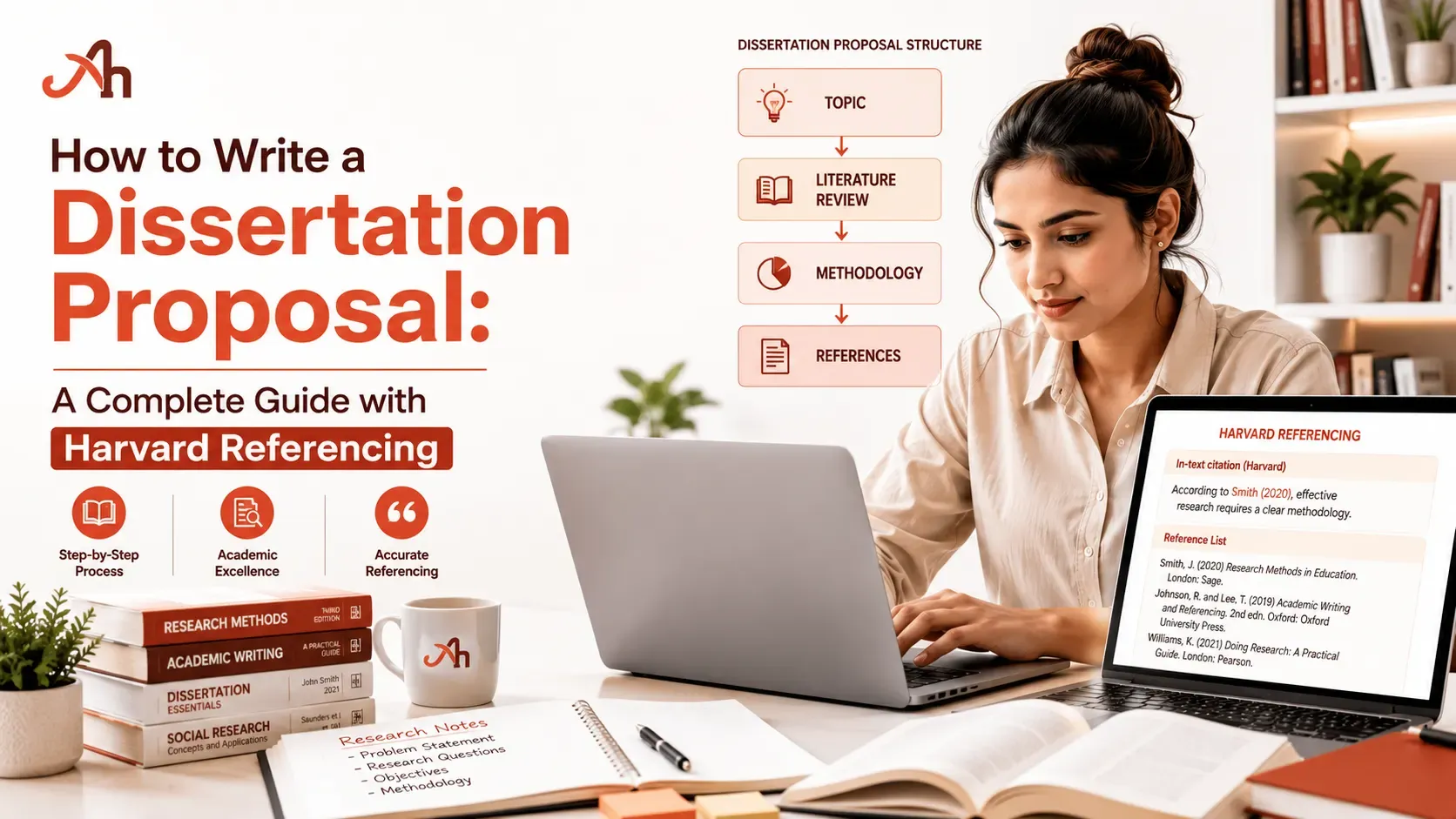
Writing a dissertation proposal can feel overwhelming, especially when you are doing it for the first time. It is the foundation of your entire research journey — get it right, and everything else falls into place. Whether you are a postgraduate student tackling a dissertation assignment or an undergraduate working on a research proposal writing task, this guide will walk you through every step. If you ever feel stuck, expert dissertation proposal help is just a click away.
What Is a Dissertation Proposal?
A dissertation proposal is a formal document that outlines what you plan to research, why it matters, and how you intend to conduct the research. Think of it as a pitch to your university or supervisor — you are convincing them that your research idea is valid, feasible, and academically significant.
It applies across every discipline — from a strategic management assignment to a corporate law assignment, and from an electrical engineering assignment to a childcare assignment. Every field demands the same rigour in proposal writing.
Why Is a Dissertation Proposal Important?
Before diving into the structure, it is crucial to understand why this document carries so much weight:
It gets your research approved before you invest months of effort
It forces you to think critically about your research question and methodology
It helps your supervisor guide you in the right direction from the start
A strong proposal often leads to a stronger final dissertation
It demonstrates your ability to conduct independent academic research
It is relevant whether you are writing a management assignment, a marketing assignment, or a full thesis assignment
Students who skip careful proposal planning often struggle later — avoid that mistake by treating the proposal seriously from day one.
Structure of a Dissertation Proposal
1. Title
Your title should be clear, specific, and academically worded. Avoid vague phrases. A good title tells the reader exactly what the research is about.
Example: "The Impact of Social Media Marketing on Consumer Buying Behaviour Among Millennials in the UK (2020–2024)"
2. Introduction
The introduction sets the scene. It should:
Briefly introduce the research topic
Explain the context and background
State why this topic is relevant today
Hint at the research gap you intend to fill
Be concise — typically 200 to 300 words
Tips for Writing a Strong Introduction
Start with a compelling opening statement or a surprising statistic
Reference recent and credible sources
Avoid going into too much detail — save the depth for the literature review
Use Harvard referencing for any cited facts (explained further below)
Students writing a history assignment or HR management assignment should tailor the introduction to reflect their specific subject context
3. Research Aim and Objectives
This is one of the most important sections. Your aim is the overarching goal of your research. Your objectives are the specific steps you will take to achieve that aim.
Structure it like this:
Aim: To investigate the relationship between sleep deprivation and academic performance among university students.
Objectives:
To review existing literature on sleep patterns among students
To collect primary data through surveys and interviews
To analyse the correlation between sleep hours and GPA scores
To recommend institutional strategies to improve student wellbeing
Keep objectives SMART — Specific, Measurable, Achievable, Relevant, and Time-bound.
Whether you are working on a risk management assignment or a corporate law assignment, well-defined SMART objectives are a mark of academic maturity.
4. Literature Review
The literature review demonstrates that you have engaged with existing research in your field. It is not a simple list of summaries — it is a critical analysis that forms the backbone of any strong research paper writing or dissertation assignment.
What to Include
Key theories and models related to your topic
Recent studies (preferably from the last 5–7 years)
Debates or contradictions in the existing research
The research gap your study will address
Common Mistakes to Avoid in Literature Review
Summarising sources without critically evaluating them
Using outdated references (pre-2010 unless foundational)
Failing to connect the literature to your own research question
Not using Harvard referencing consistently
Ignoring subject-specific journals — especially critical for fields like electrical engineering assignment or HR management assignment
Need help sourcing quality academic material? Our coursework help experts can assist you in finding and reviewing credible sources across all disciplines.
5. Research Methodology
This section explains how you will conduct your research. Supervisors pay close attention here because methodology determines the validity of your findings — whether you are submitting a case study, a thesis assignment, or a full dissertation assignment.
Key Elements of Methodology
Research Philosophy: Positivism, interpretivism, or pragmatism?
Research Approach: Inductive or deductive?
Research Design: Descriptive, exploratory, or explanatory?
Data Collection Methods: Surveys, interviews, case studies, experiments?
Data Analysis: Thematic analysis, statistical analysis, content analysis?
Sampling Strategy: Who are your participants and why?
Ethical Considerations: Consent, confidentiality, data protection
Qualitative vs Quantitative Research — Which Should You Choose?
Many students opt for a mixed-methods approach to get the best of both worlds. This is particularly common in management assignment topics and strategic management assignment research where both data types add depth.
6. Research Timeline (Gantt Chart)
Including a Gantt chart or timeline shows your supervisor you have planned your research realistically. This is equally important whether you are working on a research proposal writing task or a longer thesis assignment.
Sample Dissertation Timeline (6 Months)
Month 1: Literature review and finalising research questions
Month 2: Designing and piloting data collection tools
Month 3: Collecting primary data
Month 4: Analysing data
Month 5: Writing up findings and discussion
Month 6: Editing, proofreading, and submission
7. References (Harvard Referencing)
This is non-negotiable. Most UK universities require Harvard referencing, and errors here can cost you marks — or worse, lead to plagiarism flags. This rule applies across all subjects, including history assignment, corporate law assignment, and childcare assignment submissions.
How to Use Harvard Referencing in a Dissertation Proposal
In-text citation format: (Author's Surname, Year of Publication, Page Number)
Example: According to Johnson (2022, p. 45), academic stress significantly affects student concentration levels.
Reference list format: Surname, Initial. (Year) Title of Book. Edition. Place of Publication: Publisher.
Example: Saunders, M., Lewis, P. and Thornhill, A. (2019) Research Methods for Business Students. 8th edn. Harlow: Pearson.
Harvard Referencing Quick Rules
List all references alphabetically by surname at the end
Include every source cited in the text — no exceptions
Use "et al." when a source has more than three authors
For online sources, include the URL and date accessed
Use italics for book and journal titles
Struggling with referencing in your essay writing or research paper writing? Our assignment writing services include full Harvard referencing support across all subjects.
Top Tips to Make Your Dissertation Proposal Stand Out
Be specific — vague proposals get rejected; precise ones get approved
Justify every decision — why this topic? Why this method? Why now?
Show originality — demonstrate the gap your research will fill
Proofread thoroughly — grammar errors undermine academic credibility
Follow your university's specific guidelines — word limits and formats vary
Get feedback early — share a draft with your supervisor before final submission
Use professional support — whether it is essay writing, a case study, or a full dissertation assignment, expert guidance makes a real difference
Common Reasons Dissertation Proposals Get Rejected
Research question is too broad or too vague
No clear research gap identified
Weak or missing literature review
Unrealistic timeline or scope
Inconsistent or incorrect Harvard referencing
Methodology does not align with the research aims
Poor academic writing — particularly common when students attempt research paper writing without prior experience
Conclusion
Writing a dissertation proposal is a skill — one that improves with practice, planning, and the right guidance. By following the structure outlined in this guide, using proper Harvard referencing, and aligning your methodology with your research aims, you give yourself the strongest possible foundation for your dissertation.
Remember: a well-crafted proposal is not just a formality. It is your first major step toward producing research you are truly proud of.
If you are still unsure where to start, or simply need professional support at any stage, the team at Need Assignment Help is ready to help — from proposal drafting to full dissertation writing, referencing, and proofreading. Get expert dissertation help online today and take the stress out of academic writing.