
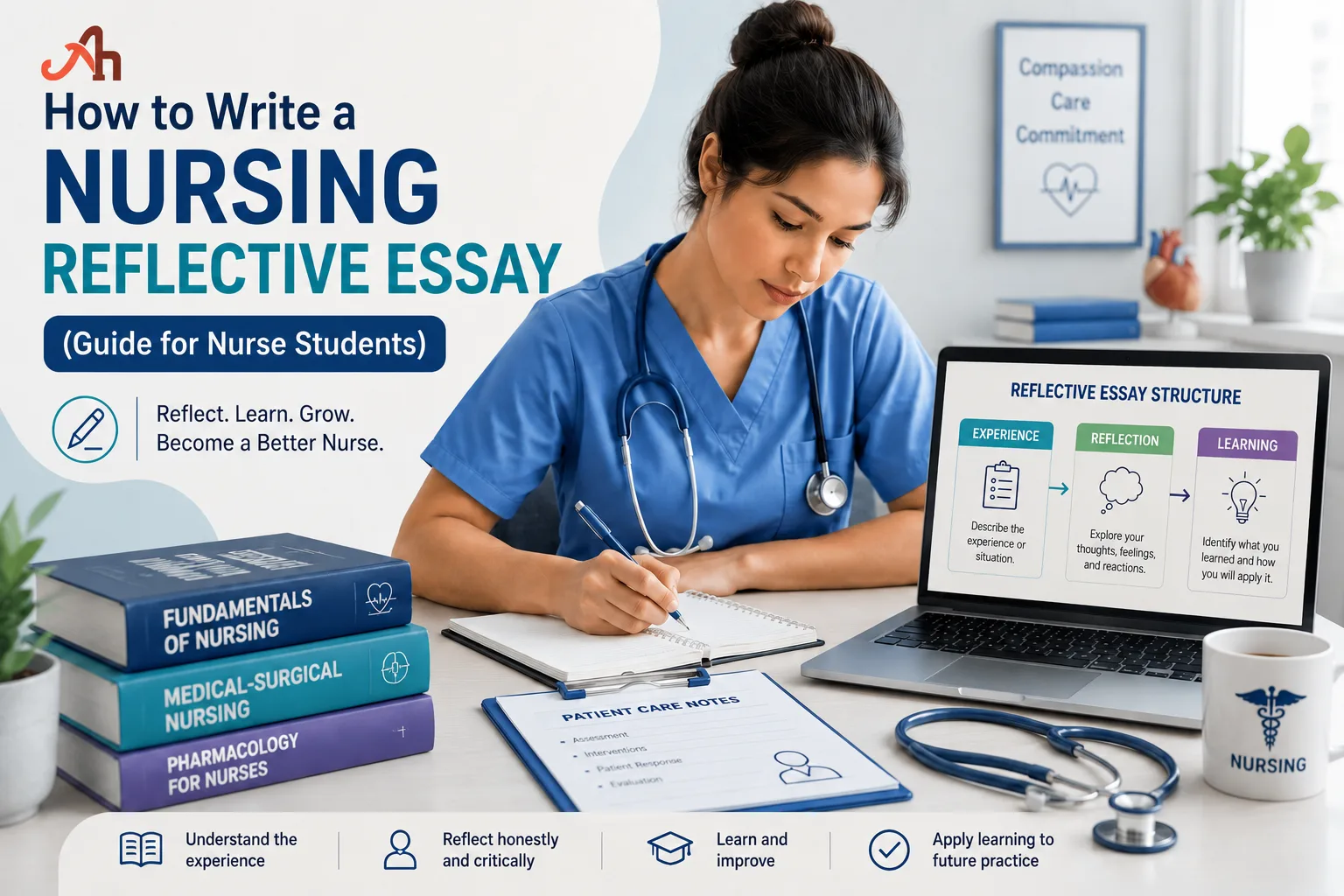
Nursing students across Australia, UK, and USA face one assignment that stands apart from all others — the reflective essay. Unlike clinical reports or research papers, a reflective essay asks you to turn the lens inward and examine your own experiences, decisions, and emotions as a nurse-in-training. Many students find this format confusing because it blends personal narrative with academic analysis. This guide breaks down every step you need to write a strong nursing reflective essay, from choosing a model to writing your conclusion with confidence.
What Is a Nursing Reflective Essay?
A nursing reflective essay is an academic piece of writing where you analyse a specific clinical experience, patient interaction, or learning moment from your nursing practice. The goal is not just to describe what happened — it is to critically examine what you felt, what you learned, and how it will change your future practice.
Reflective writing is a core skill in nursing education because healthcare professionals must continuously evaluate their own performance. Universities in Australia, UK, and the USA include reflective essays as part of coursework help requirements across nursing and health programs.
Why Do Nursing Students Write Reflective Essays?
Before writing, it helps to understand the purpose behind the task. Your lecturer is not looking for a diary entry. They want to see:
Your ability to critically assess a real nursing situation
Evidence that you can connect theory with clinical practice
Personal and professional growth as a nursing student
Awareness of patient safety, ethics, and care standards
Competency in academic writing within a health science context
Students studying health and social care assignment help topics will find reflective essays appearing throughout their degree — not just once.
Reflective Models Used in Nursing Essays
Gibbs Reflective Cycle
The most widely used framework for nursing reflection. Developed by Graham Gibbs in 1988, this model guides you through six stages:
Description — What happened?
Feelings — What were you thinking and feeling?
Evaluation — What was good or bad about the experience?
Analysis — What sense can you make of the situation?
Conclusion — What else could you have done?
Action Plan — If it happened again, what would you do?
Driscoll's Model of Reflection
A simpler three-question model ideal for shorter essays:
What? (Describe the event)
So What? (Analyse the impact)
Now What? (Plan future action)
Johns' Model of Structured Reflection
This model encourages you to draw from external knowledge — textbooks, clinical guidelines, and research — while reflecting on the experience. It suits students writing longer, research-backed reflective essays as part of their dissertation help or major assessment tasks.
Step-by-Step: How to Write a Nursing Reflective Essay
Step 1: Choose a Specific Clinical Experience
Pick one event, not a general summary of your placement. A single moment — administering medication for the first time, supporting a distressed patient, or making a clinical error — gives you enough depth to reflect on fully. Vague experiences produce vague essays.
Step 2: Pick Your Reflective Model
Check your assignment brief first. Many nursing programs specify which model to use. If not, Gibbs Reflective Cycle is the safest default for undergraduate students.
Step 3: Write a Strong Introduction
Your introduction should:
Briefly describe the clinical situation you will reflect on
State the reflective model you are using
Mention what the essay will cover
Keep it to 100–150 words (4–5 lines)
Avoid revealing your conclusions in the introduction. Let the reflection unfold naturally.
Step 4: Describe the Experience Objectively
In the description section, stick to facts. Do not interpret or evaluate yet. Answer: who was involved, what happened, when and where it occurred, and what your role was. Use first-person language — "I noticed," "I decided," "I communicated."
Step 5: Explore Your Feelings
This is where students often hold back. Reflective essays require honesty. Write about your emotional response — anxiety, confidence, confusion, empathy. Acknowledging negative feelings like self-doubt does not weaken your essay. It demonstrates self-awareness, which is exactly what examiners look for.
Step 6: Evaluate and Analyse
Now move into critical thinking. Ask:
What went well and why?
What did not go well and why?
How did nursing theory, ethics, or clinical guidelines apply here?
What do the literature and evidence say about this type of situation?
This is the section where you link your personal experience to academic sources. Use peer-reviewed journals, clinical frameworks, and your university's prescribed texts. If you struggle with sourcing or referencing correctly, referencing help is available through experienced academic support services.
Step 7: Write Your Conclusion and Action Plan
Summarise the key learning points from your reflection. Then write a forward-looking action plan: what you will do differently, what skills you want to develop, and which areas of nursing knowledge you plan to strengthen. Keep the conclusion to 4–5 lines and make it specific — not "I will try to improve" but "I will complete additional training in patient communication techniques during my next placement."
Common Mistakes Nursing Students Make in Reflective Essays
Writing a Story Instead of a Reflection
Describing what happened is only the starting point. A reflective essay must include analysis, critical thinking, and connection to theory. If your essay reads like a diary, rework it using your chosen reflective model as a scaffold.
Ignoring the Literature
Reflection without academic evidence is personal opinion. Back your analysis with nursing journals, clinical guidelines (such as NICE, NMC, or AHPNA standards), and course readings. If you need help finding reliable sources, consider using assignment help from qualified medical and science subject experts.
Being Vague About Learning Outcomes
"I learned a lot from this experience" tells the reader nothing. Be precise: "This experience showed me that therapeutic communication reduces patient anxiety during pre-operative assessments, and I will apply this in future ward rotations."
Weak Structure
Each section of your reflective model should flow logically into the next. Use clear subheadings that match your chosen framework. Messy structure is one of the top reasons students lose marks in medical/science assignment help submissions.
Formatting and Referencing Your Nursing Reflective Essay
Most nursing programs use APA 7th edition or Harvard referencing. Key formatting tips:
Use first-person throughout ("I felt," "I observed")
Maintain confidentiality — anonymise all patient details (use pseudonyms like "Patient A")
Word count is usually 1,000–2,500 words for undergraduate reflective essays
Use headings aligned with your reflective model
Cite all nursing theories, clinical frameworks, and journal articles
If you are unsure about your referencing style or want someone to review your draft before submission, proofreading help can catch errors in citations, grammar, and structure before your final submission.
Need Help Writing Your Nursing Reflective Essay?
Writing a reflective essay for the first time can feel overwhelming. The format is unlike anything taught in school, and the expectation to be both personal and academically rigorous is a steep learning curve. If you are stuck on structure, unsure how to apply a reflective model, or running short on time, professional essay writing help from qualified nursing and health science writers can get you on track fast.
You might also find it useful to read our related guide: How to Write a Health and Social Care Assignment — which covers overlapping skills including patient-centred care theory, ethical frameworks, and academic writing standards used across nursing and allied health programs.
Conclusion
A nursing reflective essay is your opportunity to prove that you are not just learning clinical skills — you are growing as a thoughtful, self-aware healthcare professional. Choose a specific experience, apply a recognised reflective model like Gibbs or Driscoll, and back your analysis with credible nursing literature. Keep your introduction and conclusion tight, stay honest in your feelings section, and always connect personal learning to future professional action. With the right structure and the right support, a reflective essay becomes one of the most rewarding assignments in your nursing degree.
Frequently Asked Questions
Q. What is the best reflective model to use for a nursing essay?
Gibbs Reflective Cycle is the most widely recommended model for nursing students writing their first reflective essay.
Q. Can I use first-person in a nursing reflective essay?
Yes, first-person writing is required and expected in nursing reflective essays throughout your academic submission.
Q. How long should a nursing reflective essay be for undergraduate students?
Most undergraduate nursing reflective essays range between 1,000 and 2,500 words depending on your university's guidelines.
Q. Do I need to include references in a nursing reflective essay?
Yes, you must support your analysis with academic sources, clinical guidelines, and nursing literature using correct referencing style.
Q. How do I maintain patient confidentiality in a nursing reflective essay?
Always anonymise patient details by using pseudonyms or labels like "Patient A" to protect individual privacy throughout your essay.