
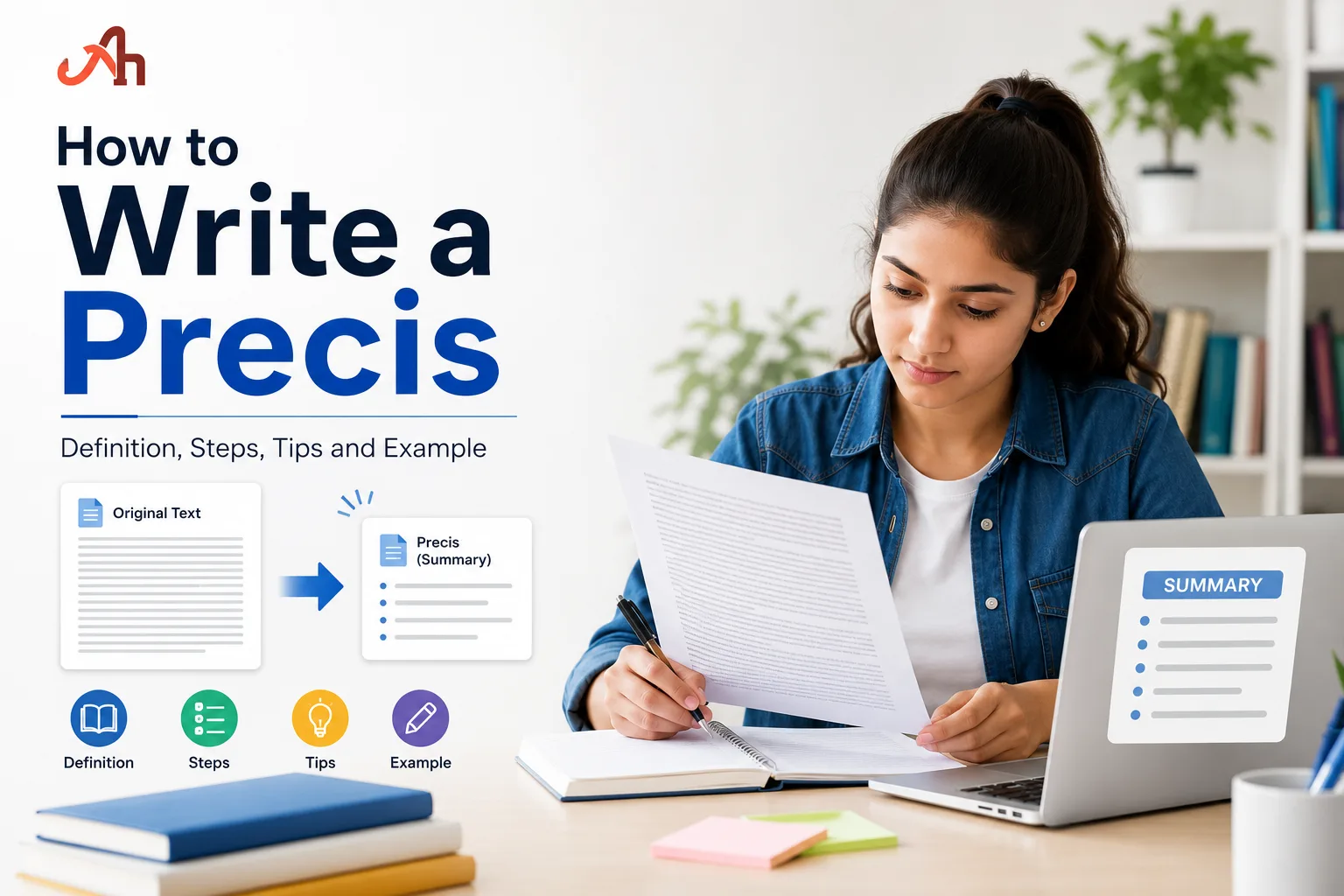
Writing a precis is one of the most essential academic skills every student must develop. Whether you are working on an English assignment, preparing for university exams, or submitting a research paper, knowing how to write a precise and concise summary can dramatically improve your academic performance. A well-written precis demonstrates your ability to read critically, comprehend complex arguments, and communicate ideas clearly — skills that are valued across every subject and discipline.
What Is a Precis?
A precis (pronounced pray-see) is a concise, clear, and accurate summary of a longer passage, article, essay, or speech. The word comes from the French term meaning "precise" or "exact." Unlike a general summary, a precis must faithfully retain the logic, order, tone, and key arguments of the original text — but in your own words and in a significantly reduced length, typically one-third of the original.
Key Characteristics of a Precis
It is written in the third person
It maintains the same logical sequence as the original
It is approximately one-third the length of the source text
It does not include the writer's personal opinion
It uses direct, formal language
It is self-contained — readable without referring to the original
Why Is Learning to Write a Precis Important for Students?
Students across subjects — from English and communication to law, management, and economics — are regularly assessed on their ability to summarize complex information. A precis helps you:
Sharpen critical reading and analytical thinking
Improve academic writing and essay composition skills
Demonstrate understanding in coursework help tasks and examinations
Build the foundation for writing research papers and dissertations
Save time when reviewing lengthy academic texts
If you're struggling with academic writing tasks, professional assignment help services like NeedAssignmentHelp can guide you through every step with expert support.
Step-by-Step Guide: How to Write a Precis
Step 1 — Read the Original Text Thoroughly
Before writing anything, read the passage carefully — at least twice. On your first reading, focus on the overall meaning and tone. On your second reading, identify:
The main argument or thesis
Supporting points and evidence
The conclusion or final stance of the author
Avoid highlighting everything. Instead, note the central ideas that cannot be omitted without losing the meaning of the text.
Step 2 — Identify the Main Idea and Tone
Every piece of writing has a central theme. Ask yourself:
What is the author trying to convey?
What is the tone — formal, persuasive, analytical, argumentative?
Who is the intended audience?
In academic writing — whether it's an argumentative essay, a reflective essay, or a research proposal — tone matters as much as content. Your precis must reflect the same tone as the original.
Step 3 — Make a Rough Draft
Once you have identified the key points, write a rough outline. Organize ideas in the same sequence as the original text. Do not rearrange the author's logic to suit your preference.
Your rough draft should:
Begin with the author's name, the title of the work, and the central argument
Follow the same structural flow as the original
Use paraphrased language — never copy verbatim sentences
Avoid adding examples, analogies, or explanations not present in the source
Step 4 — Write the Precis in Third Person
A precis is always written in the third person. This is a common mistake students make. Instead of writing "I believe the author argues…", write "The author argues…" or "Smith contends that…"
This maintains academic objectivity — a standard required across disciplines including law assignments, management studies, and business communication.
Step 5 — Keep It to One-Third the Original Length
One of the defining rules of a precis is its length. If the original passage is 600 words, your precis should be approximately 200 words. This forces you to prioritize the most critical information and eliminate:
Repetition and redundancy
Examples that are merely illustrative
Transitional filler phrases
Personal anecdotes or background detail
This skill is especially useful in academic report writing and when summarizing chapters for thesis help or dissertation help projects.
Step 6 — Revise and Proofread
After drafting your precis, review it carefully. Ask:
Does it cover all the main points of the original?
Is the sequence and logic maintained?
Is it written in your own words?
Is the tone consistent with the original?
Is it free from grammatical and spelling errors?
Proofreading is a non-negotiable step. If you frequently struggle with grammar and clarity, a professional proofreading help service can ensure your final submission is polished and error-free.
Essential Tips for Writing a Precis
Here are practical tips that students often overlook:
Never include your own opinion. A precis is a representation of the author's ideas, not yours.
Use formal academic language. Avoid colloquialisms, slang, or casual phrases.
Do not use direct quotations. Paraphrase everything in your own words.
Start with a strong opening sentence that names the author, the title (if applicable), and the central argument.
Stick to the original order. Restructuring the content is a common error that leads to marks being deducted.
Read a variety of texts regularly. Students who read widely — across subjects like economics, psychology, mass communication, and political science — develop stronger precis-writing instincts.
Practice summarizing news articles and academic papers to build speed and accuracy.
Ask for expert feedback — whether from a tutor or through a trusted homework help platform.
Common Mistakes to Avoid
What Students Get Wrong Most Often
Writing in the first person ("I think…", "In my view…")
Including personal examples or outside information
Copying exact sentences from the original text
Changing the sequence of ideas
Making the precis too long or too short
Ignoring the tone of the original (e.g., treating a persuasive piece as neutral)
Forgetting to mention the author and source in the opening line
Precis vs Summary: What's the Difference?
Many students confuse a precis with a summary. Here's a quick breakdown:
Precis
Strict length rule (one-third)
Maintains the original tone
Written in third person
No personal opinion
Follows original order precisely
Summary
Flexible length
May shift tone
Can be first or third person
Sometimes includes brief personal remarks
May reorder ideas for clarity
Both are critical skills in academic writing, but a precis demands a higher degree of precision and discipline.
Precis Writing Example
Original Passage (approximately 120 words):
"Education is not merely the transmission of knowledge from teacher to student. It is a process through which students learn to think critically, question assumptions, and engage with the world in a meaningful way. Schools and universities must go beyond rote memorization and encourage creativity, problem-solving, and independent thought. When students are taught to analyse information rather than simply absorb it, they become lifelong learners capable of adapting to change. In today's fast-paced global economy, the ability to think flexibly and communicate effectively is more valuable than any single piece of information a student can memorise."
Precis (approximately 40 words):
The author argues that education is a transformative process that extends beyond knowledge transmission, emphasising critical thinking, creativity, and independent reasoning. Schools must prioritise analytical skills over rote learning to equip students with the adaptability and communication abilities demanded by the modern global economy.
Notice how the precis:
Names the author's position clearly
Retains all key ideas in the correct order
Uses third person throughout
Contains no personal opinion or new information
Is approximately one-third the length
How NeedAssignmentHelp Can Support Your Academic Writing
Writing a precis is just one of many academic writing challenges students face. Whether you need support with essay writing, coursework help, a case study, or a complete dissertation, expert guidance makes a significant difference.
NeedAssignmentHelp provides:
Professional assignment help across all subjects
Dedicated English assignment and writing support
Expert research paper writing and academic report writing
Reliable proofreading and editing services
100% original, plagiarism-free content
Students from Australia, the UK, and the USA trust the platform for its on-time delivery, qualified PhD-level writers, and comprehensive coverage of subjects — from management and law to nursing, engineering, and computer science.
Conclusion
A precis is a powerful academic skill that trains you to read with purpose, think critically, and write with precision. By following the defined steps — reading carefully, identifying the central argument, drafting in sequence, writing in third person, and revising thoroughly — any student can master this skill. Consistent practice is the key. The more you engage with complex texts across disciplines, the more naturally concise and accurate your writing will become. And when academic demands feel overwhelming, remember that expert assignment help is always available to guide you toward success.