
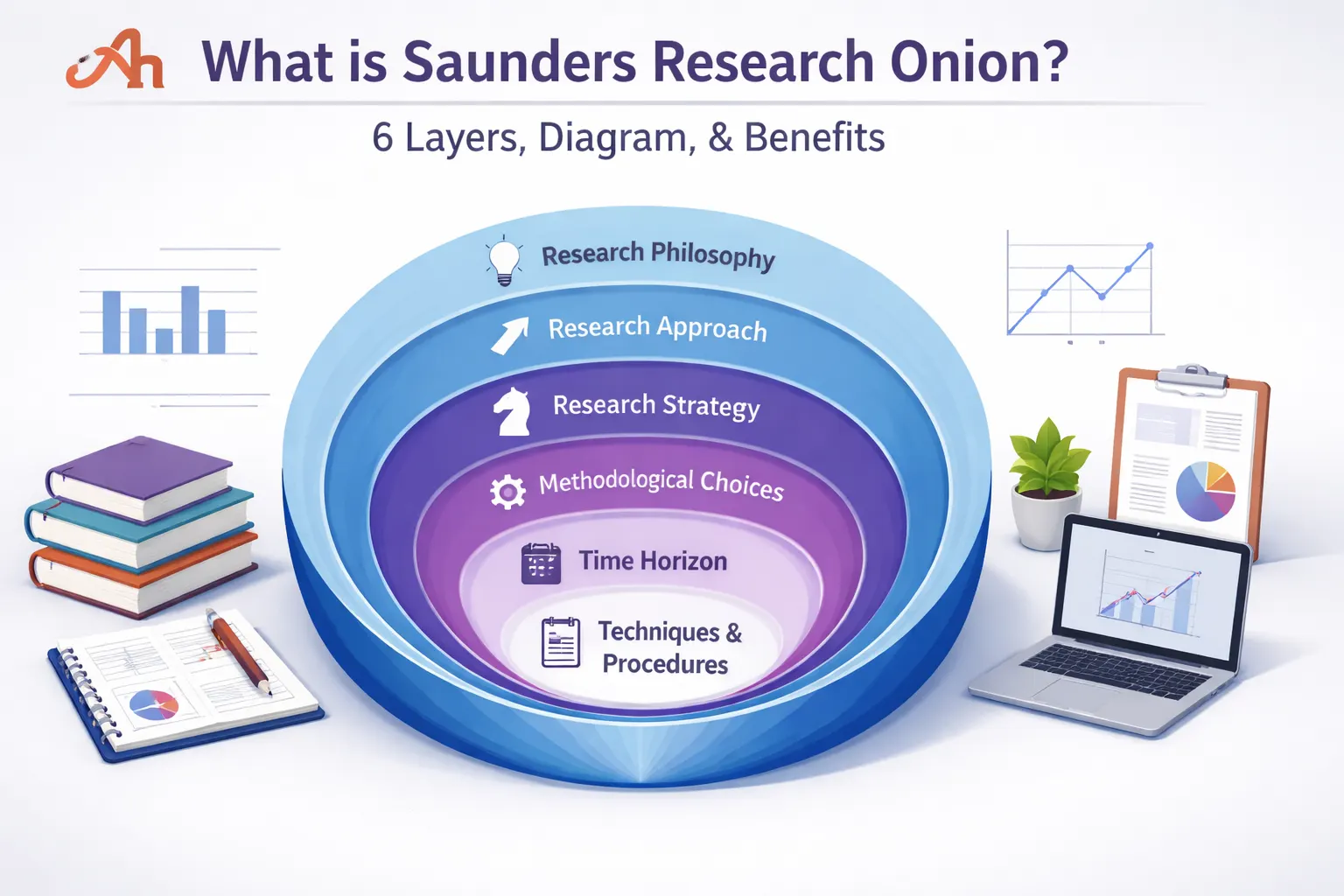
If you're working on a dissertation, research paper, or any assignment help task, understanding the Saunders Research Onion is an absolute must. Introduced by Saunders, Lewis, and Thornhill, this model simplifies complex research decisions into six clear, concentric layers — much like peeling an onion. Whether you're studying strategic management, economics, or pursuing thesis help, this guide will walk you through everything you need to know about the Research Onion Model in simple, student-friendly language.
What Is the Saunders Research Onion?
The Saunders Research Onion is a visual and conceptual framework used to design and plan academic research. First introduced in the book Research Methods for Business Students, the model helps researchers — from undergraduates to doctoral candidates — make structured decisions about how their research will be conducted.
Just like an onion has multiple layers, the Research Onion Model consists of six layers, each representing a different stage of the research design process. You begin from the outermost layer and work your way inward, making one key decision at each stage before moving on to the next.
The model is not just a diagram — it is a complete decision-making road map that ensures your research is methodologically sound and academically credible. It is especially popular in business, social sciences, and management studies.
6 Layers of Research Onion Explained
Here is a detailed breakdown of all 6 Layers of Research Onion — what each layer means, what choices it includes, and why it matters for your research.
Layer 1 — Research Philosophy (Outermost Layer)
Research philosophy refers to the set of beliefs and assumptions about how knowledge is created and developed. It forms the foundation of your entire research design.
The four major research philosophies are:
Positivism — believes in objective, measurable, and observable reality; commonly used in quantitative research
Interpretivism — focuses on understanding human behaviour and subjective meaning; used in qualitative research
Realism — acknowledges that reality exists independently of the human mind; a middle ground between positivism and interpretivism
Pragmatism — focuses on practical outcomes; often used in mixed-method research designs
Your choice of philosophy will directly influence every other layer of your research design, so it must align with your research topic and objectives.
Layer 2 — Research Approach
Once you have selected your philosophy, the next layer defines how you will develop or test theory in your study. There are three main approaches:
Deductive Approach — you begin with an existing theory or hypothesis and test it through data collection
Inductive Approach — you collect data first and build a new theory based on your findings
Abductive Approach — a combination of both; you move back and forth between data and theory to develop the best explanation
Students writing dissertations or seeking thesis help frequently use the deductive approach when working with existing literature and hypotheses.
Layer 3 — Research Strategy
The strategy layer defines the overall plan or blueprint for your research. It answers the question: How will the research be conducted? Common research strategies include:
Experiment — controlled testing of variables
Survey — data collected from a large sample using questionnaires
Case Study — in-depth investigation of a specific individual, group, or organisation
Action Research — research conducted alongside practical intervention
Grounded Theory — theory developed directly from data
Ethnography — study of people in their natural environment
Archival Research — analysis of existing historical records and documents
Students in HR management, strategic management, and business studies most commonly use surveys and case studies as their research strategy.
Layer 4 — Research Choices
This layer covers the decision about what type of data you will collect and whether you will use one method or multiple methods. The three choices are:
Mono-method — uses a single research method, either qualitative or quantitative
Multi-method — uses more than one method within the same qualitative or quantitative approach
Mixed-method — combines both qualitative and quantitative data collection and analysis
For students seeking coursework help or completing final-year research projects, mixed-method designs are increasingly popular as they produce richer and more comprehensive findings.
Layer 5 — Time Horizon
The time horizon layer determines the timeframe within which your research is conducted. There are two options:
Cross-sectional — data is collected at a single point in time; like a snapshot of a situation; common in student dissertations due to time constraints
Longitudinal — data is collected over an extended period to observe changes and trends over time
Students working on economics assignments or accounting assignments often opt for cross-sectional studies, while those in social sciences may prefer longitudinal designs.
Layer 6 — Data Collection & Analysis (Innermost Core)
The innermost core of the Research Onion covers the actual techniques used to gather and analyse your data. This is where all your previous decisions come together. Common data collection methods include:
Interviews — structured, semi-structured, or unstructured conversations with participants
Questionnaires — standardised questions distributed to a sample group
Observation — watching and recording behaviour in natural settings
Focus Groups — group discussions to gather diverse opinions
Secondary Data — existing data from reports, databases, journals, or government sources
Experiments — controlled studies to test cause-and-effect relationships
All your choices from layers 1 through 5 directly shape which data collection techniques are most appropriate at this final stage.
Why Is Saunders Research Methodology Important for Students?
The Saunders Research Methodology framework is taught in universities across the UK, US, Australia, Canada, and beyond. Here is why students find it absolutely indispensable:
It provides a clear, structured approach to designing complex academic research
It helps avoid common methodological mistakes that can significantly reduce grades
It is applicable across disciplines — from English assignments to history assignments to business research
It gives researchers a logical sequence to follow, reducing confusion during the writing process
Supervisors and examiners expect students to justify their methodology using a recognised model
It is essential when writing the methodology chapter of a dissertation or thesis
It demonstrates academic maturity and methodological awareness to examiners
Benefits of Using the Research Onion Model
There are several compelling benefits of adopting the Research Onion Model in your academic work:
Clarity and Structure — breaks down the entire research design process into six easy, manageable layers
Logical Coherence — ensures that each methodological decision naturally aligns with the others, avoiding contradictions
Wide Academic Acceptance — recognised and recommended by universities, supervisors, and journal editors worldwide
Cross-Disciplinary Application — works equally well across business, humanities, social sciences, and STEM fields
Examiner-Friendly Format — demonstrates methodological awareness, a key criterion in dissertation and thesis grading
Time-Saving — provides a ready-made framework so you spend less time planning and more time researching
Reduces Errors — by following the layers in order, you avoid mismatched methods and unjustified choices
Common Mistakes Students Make with the Research Onion
Even with this clear framework, students often make avoidable errors. Here are the most common mistakes to watch out for:
Skipping the philosophy layer entirely and jumping straight to data collection methods
Confusing research approach (deductive/inductive) with research method (interview/survey)
Choosing a strategy that contradicts the selected philosophy — for example, pairing positivism with purely interpretive ethnography
Ignoring the time horizon layer and not specifying whether the study is cross-sectional or longitudinal
Failing to justify each layer with reasoning — examiners want your logic, not just your labels
Using the Research Onion as decoration in the methodology chapter without genuinely applying it
Students looking for essay writing or homework help on methodology chapters should pay particular attention to justifying each layer clearly in relation to their own research topic.
Research Onion in Different Academic Disciplines
The 6 Layers of Research Onion are relevant across a wide range of subjects. Here is how students in different fields typically apply the model:
English Assignment & Humanities — Interpretivism + Inductive + Ethnographic or Archival strategy; ideal for textual and discourse analysis
Accounting Assignment & Finance — Positivism + Deductive + Survey or Secondary Data; suits quantitative financial research
Strategic Management — Pragmatism + Mixed-Method + Case Study; aligns well with competitive and corporate analysis
Economics Assignment — Positivism + Deductive + Experiment or Survey; fits econometric and policy research
History Assignment — Interpretivism + Inductive + Archival Research; perfect for document-based historical studies
HR Management — Realism or Interpretivism + Inductive + Interviews or Focus Groups; suits employee behaviour and organisational culture research
If you need professional support with any of these subjects, explore our case study help, coursework help, and dissertation help services.
Conclusion
The Saunders Research Onion is a powerful and globally recognised framework that simplifies the entire research design process into six logical, interconnected layers. From choosing a research philosophy to selecting data collection methods, every decision you make becomes clearer and more justified when guided by this model. Students across all disciplines — from strategic management and economics assignment to history assignment and HR management — can apply it effectively in their dissertations and research papers. If you still find the methodology chapter overwhelming, our professional dissertation help, thesis help, and assignment help services are here to support you every step of the way.