
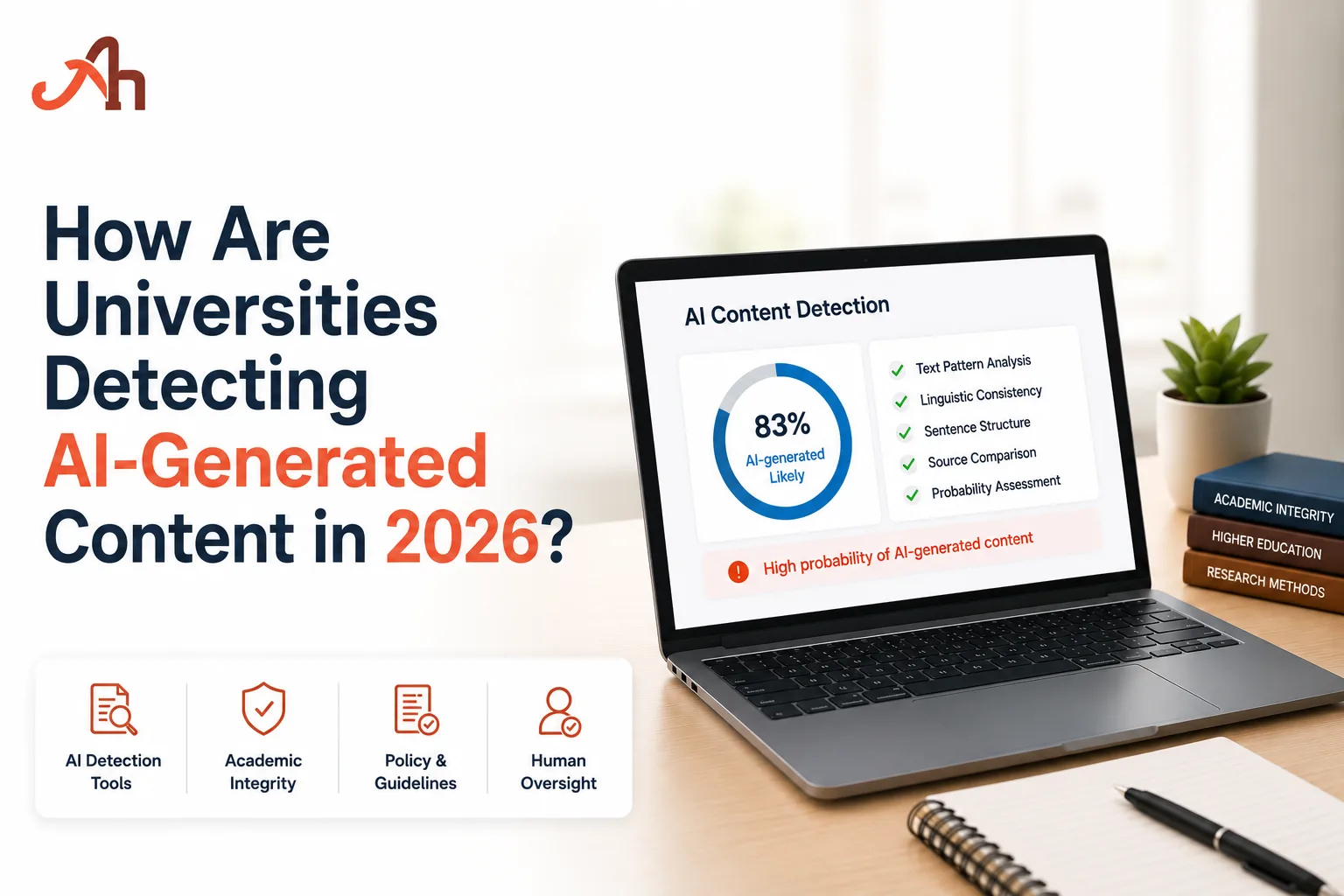
Generative AI is now part of how most students research, outline, and draft. In response, universities have quietly bolted a detection layer onto every submission portal, from first-year coursework to final dissertations. This guide explains the actual technology behind that layer, what professors look for beyond the software, and how you can lean on AI tools for research and essay writing without putting your grade at risk.
Why AI Detection Has Become a Campus-Wide Priority
Generative AI adoption among students has moved from a niche shortcut to near-universal habit, and universities have had to respond just as fast. Instead of blanket bans, most institutions in 2026 run detection as one signal among several — a screening step that triggers a human conversation rather than an automatic penalty. That shift matters for anyone using AI to support assignment help, coursework help, or dissertation help, because the bar isn't "did you touch AI at all" — it's whether the final work reflects your own understanding.
The Core Detection Technology Universities Rely On
Most institutional systems combine three or four independent signals before flagging a paper. Here's what each one actually measures.
AI Text Classifiers and Perplexity Scoring
Classifiers score how "predictable" your word choices are. AI-generated sentences tend to pick the statistically likely next word, producing low perplexity and low burstiness — a flat, evenly-paced rhythm. Human writing is messier: sentence length varies, word choice is less uniform, and ideas jump around slightly. The trouble is that tightly structured academic prose can accidentally mimic that same flatness, which is one reason these scores are treated as probabilities, not proof.
Writing-Pattern and Stylometry Analysis
Beyond raw probability, some tools build a stylistic fingerprint — vocabulary range, punctuation habits, transition-word usage, paragraph rhythm — and compare it across your submissions over a semester.
Comparing Your Essay Against Your Own Writing Baseline
If your in-class writing sample looks nothing like your take-home submission, that gap becomes the real red flag, more than any single AI score.
Why a Personal Baseline Matters
A baseline turns detection from "does this look like AI" into "does this look like you," which is a fairer and more defensible comparison for both sides.
Quick fact
Independent testing has repeatedly shown higher false-positive rates for non-native English writers, which is why universities are told to treat a single flag as a starting point for review, not a verdict.
Metadata and Draft-History Tracking
Many institutions now ask for Google Docs or Word version history alongside a submission. A document that appears fully formed in one paste event, with no edit trail, reads very differently from one built across several sittings — which is exactly the kind of "process forensics" more academic-integrity offices are leaning on instead of a single AI score.
Turnitin's AI Writing Indicator and the Wider Toolkit
Turnitin remains the most common tool because it's already built into existing plagiarism workflows, but it rarely works alone. Your university may be running any combination of:
- —Turnitin's AI Writing Indicator — flags text likely generated by tools like ChatGPT or Claude, now updated to catch AI-humanizer and paraphrasing-tool patterns as well.
- —GPTZero — popular with individual instructors for its sentence-level breakdown and free tier.
- —Copyleaks and Originality.ai — often used alongside Turnitin for cross-verification.
- —DrillBit — the dominant combined plagiarism-and-AI checker across many Indian universities and UGC-affiliated institutions.
Beyond Software — How Professors Manually Spot AI Writing
Experienced graders often notice AI involvement before any score comes back. Common tells include:
- •A sudden jump in vocabulary or sentence complexity compared to earlier work
- •Generic examples that don't connect to lecture content or set readings
- •Flawless grammar paired with a shallow or repetitive argument
- •Citations that don't quite match the claim they're supporting
- •An inability to explain or defend the essay's own reasoning when asked directly
What Happens When Your Work Gets Flagged?
A high AI score is a trigger for review, not an automatic penalty at most universities. The typical process looks like this:
- —The flag is logged and routed to the course instructor, not published on your transcript.
- —The instructor cross-checks it against draft history, in-class writing, and your citation pattern.
- —You're usually invited to a meeting to explain your process before any formal case opens.
- —Sanctions require corroborating evidence — the AI score alone is rarely treated as sufficient.
How to Use AI Tools Without Risking Academic Integrity
You don't need to avoid AI entirely — you need a workflow that keeps the thinking yours.
- —Use AI for brainstorming, outlining, or explaining a concept — not for generating final submission text.
- —Keep your draft history visible in Google Docs or Word so your process is easy to verify.
- —Check your course handbook: some programs require disclosure of any AI assistance used.
- —Run a plagiarism check before submission — catching an issue yourself beats a flag from your university's system.
- —Get a human pass on tone and argument through proper proofreading help, since AI-smoothed prose is one of the easiest patterns for classifiers to catch.
- —Always verify citations manually using your required style through proper referencing help — AI tools regularly invent or misattribute sources.
What are the best AI Tools for Academic Research in 2026?
Common Mistakes Students Make With AI Writing Tools
- •Relying on "humanizer" or paraphrasing tools — Turnitin's 2026 update specifically targets this pattern, and scores can spike once it's detected.
- •Submitting the AI's first draft with no personal edit pass.
- •Letting AI generate citations or quotes without checking they actually exist.
- •Not being able to explain their own paper's argument if asked in class or a viva.
How NeedAssignmentHelp Keeps Your Work Original and Exam-Ready
Every order at NeedAssignmentHelp goes through human subject-matter writers, not AI generation, followed by an originality check before delivery. Whether you need assignment help, dissertation help, thesis help, or support with a specific case study, our process is built around a documented draft trail and proper citations — the exact two things detection systems are now designed to check.
Conclusion
University AI detection in 2026 is less about a single "gotcha" score and more about a full picture — classifier probability, writing baseline, draft history, and a professor's own judgment. No tool is accurate enough to be used alone, which is exactly why so many institutions now pair it with human review. Used well, AI can still support your research and planning without putting your grade at risk. The safest habit is simple: keep your process visible, your citations real, and your final argument genuinely your own.
Frequently Asked Questions
Q. Can Turnitin's AI detector be wrong?
Yes. Turnitin states its AI score is a probability, not proof, and false positives are more common in edited or non-native English writing.
Q. Will one AI flag get me expelled?
Unlikely. Most universities require faculty review and supporting evidence before any formal academic-integrity case or sanction begins.
Q. Do all universities use Turnitin's AI checker?
No. Some, like Curtin and Vanderbilt, have disabled it in 2025–2026, so policies differ significantly by institution.
Q. Is using ChatGPT for research always considered cheating?
Not usually. Most policies allow AI for brainstorming or research, but require the final written argument to be your own.
Q. How can I lower my AI-detection risk honestly?
Keep visible draft history, edit AI-assisted text heavily in your own voice, and verify every citation before submission.